
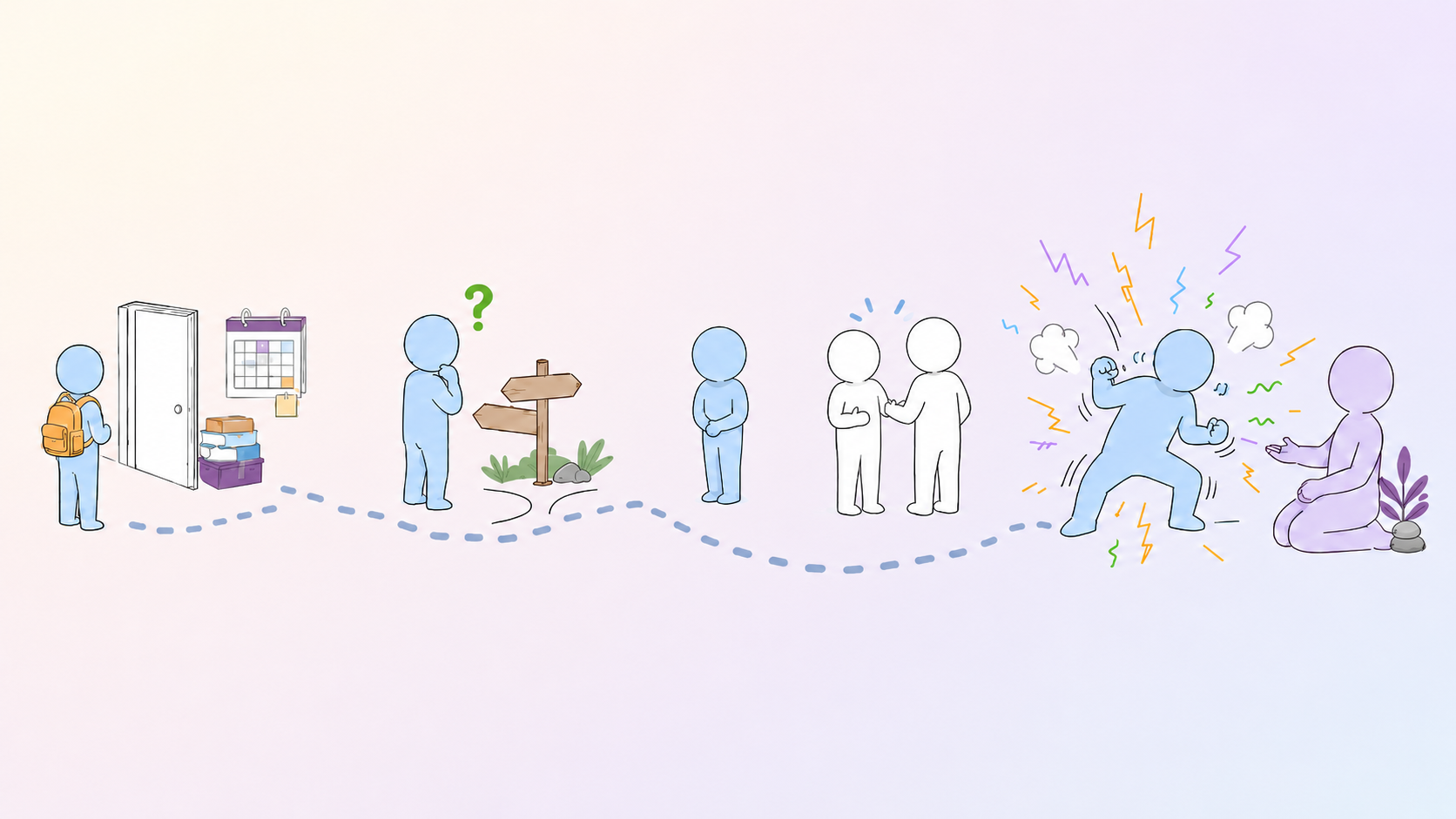
Strong energy states — the ones often labeled as outbursts, meltdowns, aggression, or “challenging behavior” — are rarely about the moment they happen in.
They’re usually about everything that came before.
For many neurodivergent learners, strong energy is the end of a long chain:
- accumulated demand
- stretched regulation
- sensory overload
- uncertainty
- transitions
- effortful masking
- a body that has been holding too much for too long
By the time the strong energy appears on the outside, the nervous system has often been working hard for hours — sometimes days.
And for adults supporting neurodivergent learners, that can be easy to miss.
Especially when the learner looked “fine” right before they weren’t.
Strong Energy Is Information
One of the most important shifts we can make is moving away from the question:
“How do we stop this behavior?”
and toward:
“What is this nervous system trying to communicate?”
Because strong energy is information.
It tells us something about what the body needed before the moment arrived:
- more time
- more predictability
- less demand
- more sensory support
- more co-regulation
- more connection
- more felt safety
This doesn’t mean boundaries disappear.
It doesn’t mean adults stop supporting safety.
But it does change what we understand the moment to be.
A meltdown is not manipulation.
A surge is not a calculated choice.
A nervous system in overload is not accessing reflection, reasoning, or flexible problem-solving in the same way it can during regulated moments.
When we treat strong energy only as behavior to control, we often miss the conditions that created it.
Why Strong Energy Often Increases During Periods of Change
Certain times, environments, and life transitions place enormous strain on regulation systems.
For neurodivergent learners, strong energy often increases during periods of:
- disrupted routines
- increased sensory load
- uncertainty
- social demands
- transitions
- reduced predictability
- emotional stress
- accumulated fatigue
Sometimes this happens during the end of the school year.
Sometimes it happens during holidays, travel, substitute coverage, family stress, illness, schedule changes, or major life transitions.
At the same time, the nervous system is often already tired from sustained effort.
For some learners, what adults experience as “sudden behavior” is actually the visible end of an invisible accumulation process.
And for learners whose nervous systems experience demand as stress — including many PDA profiles — the combination of uncertainty, expectation, sensory load, and adaptation can rapidly increase nervous system activation.
Not because the learner wants things to be hard.
Because there is simply less left to give.
Strong Energy Often Begins Long Before the Moment
One of the challenges with supporting regulation is that we tend to focus on the peak moment — the yelling, throwing, hitting, fleeing, collapsing, or shutting down.
But nervous systems usually communicate long before that point.
Sometimes the early signals look like:
- increased silliness
- pacing
- withdrawal
- refusal
- controlling behavior
- repetitive questioning
- irritability
- shutting down language
- increased movement
- becoming unusually quiet
These are often attempts at regulation before the nervous system loses access to more flexible coping.
When adults learn to notice these earlier signals, support can happen before the learner reaches overload.
Co-Regulation Before Crisis
One of the biggest misconceptions about strong energy is that the support begins during the escalation.
In reality, the most meaningful regulation work usually happens beforehand.
It happens in the calm moments:
- when shared language is built
- when body signals are noticed together
- when adults help learners connect sensations to experiences
- when there is enough safety for reflection
- when understanding is built without pressure
This is where co-regulation matters.
Not as a technique.
As a relationship.
A nervous system that has experienced consistent, regulated support begins to develop familiarity:
- with body sensations
- with emotional shifts
- with recovery
- with asking for help
- with recognizing needs before overload
And importantly, this work cannot happen only in the middle of crisis.
The language has to exist before the moment arrives.
Building Shared Language Around Strong Energy
At Shared Stories Studio, the Strong Energy series was created to support exactly this kind of understanding.
Not as a behavior plan.
Not as a consequence system.
Not as a script for compliance.
But as co-created shared narratives that help learners:
- notice body signals
- recognize patterns
- connect experiences to nervous system states
- build vocabulary around strong feelings and activation
- develop shared understanding with trusted adults
The stories are leveled across A, B, and C to support learners at different stages of understanding and communication:
- Level A supports early awareness and shared experience
- Level B supports pattern recognition and connection-making
- Level C supports reflection and emerging self-advocacy
The goal is not to eliminate strong energy.
The goal is to help learners and adults understand it together.
Because when understanding comes first, regulation has somewhere to land.
A Different Question
If you’re supporting a neurodivergent learner through strong energy states, it may be worth asking:
What has this nervous system been carrying before the moment we can see?
And what would it mean to support the signals — not just respond to the surge?
Get the Free Guide and Notes from the Studio
You’ll receive the free guide first, followed by occasional practical notes on regulation-first, neurodiversity-affirming support.