
Appointment Support for Autistic Learners Begins with the Adults, Too
You know the feeling.
The appointment is days away, and something in you is already bracing.
You run through the variables: how the waiting room might smell, whether the provider will be running late, what you will do if the learner you are accompanying cannot tolerate the exam chair today. You rehearse explanations you might need to give to strangers. You picture the look on the face of the person at the front desk.
By the time the morning of the appointment arrives, you may have been preparing for it in your body for longer than you can name.
This is not anxiety in the way people often dismiss it.
This is your nervous system doing what nervous systems do: scanning forward, preparing for uncertainty, and trying to get you ready for something that cannot fully be predicted.
And for the autistic children and learners we love and support, appointments can carry a particular kind of weight. Many adults have felt that weight too, even if we have never said so out loud.
We need to talk about that.
Looking for a ready-to-use support for appointments, body signals, and adult-held regulation?
Why the adult’s experience gets left out
When we think about appointment preparation, we almost always frame it as something we do for the learner.
We gather the social narrative.
We make the visual schedule.
We pack the comfort object.
We preview what might happen.
We try to stay regulated so the learner can borrow from our steadiness.
But we rarely name what is happening in us.
There are a few reasons for this.
Part of it is the belief that our distress is not relevant — that bringing it into the room would make things worse, not better.
Part of it is the quiet shame of struggling with something that “should” be manageable.
And part of it is the deeply human impulse to protect the learner from our own anticipatory dread by keeping it invisible.
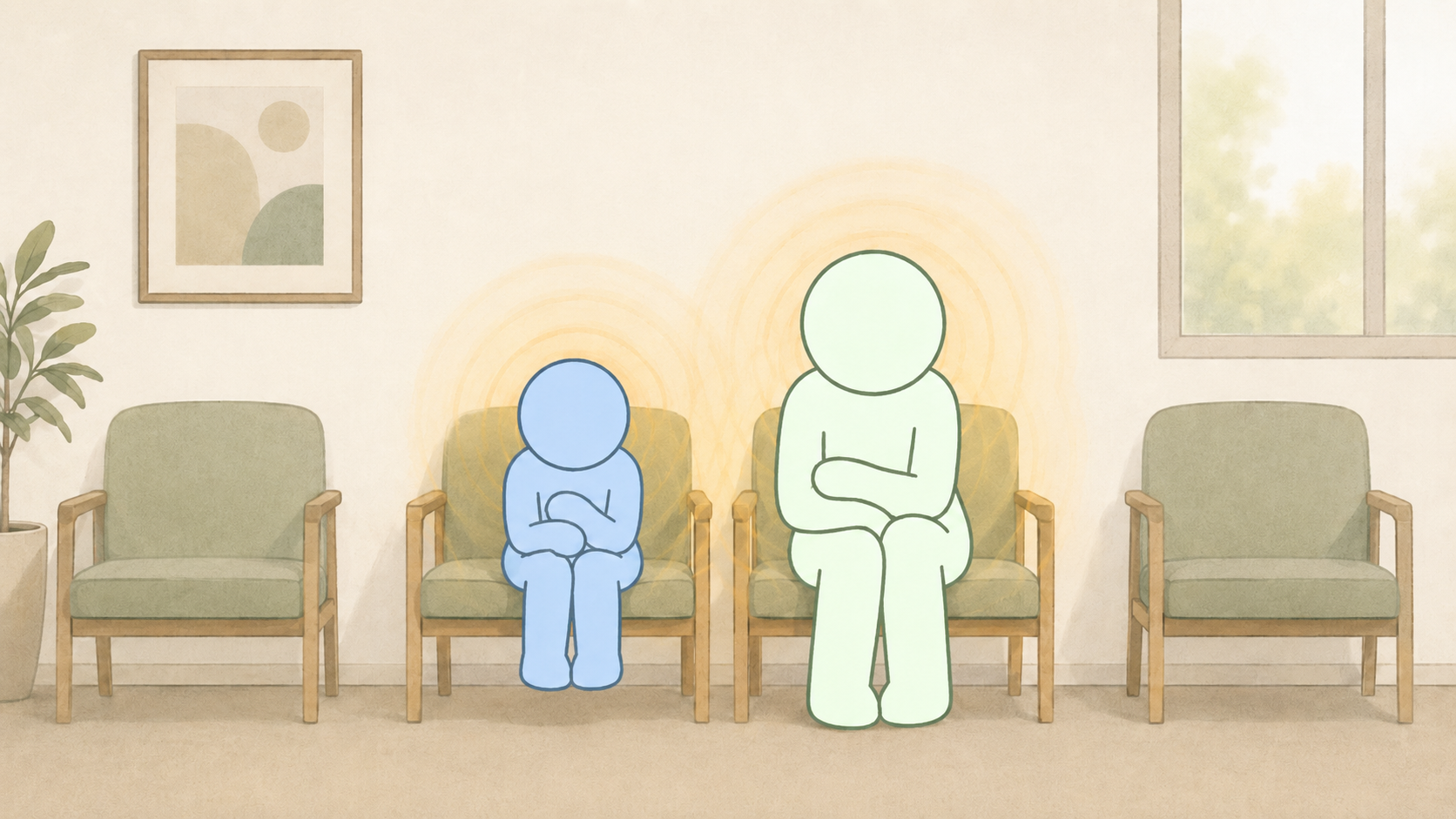
But what often happens instead is that our nervous systems communicate what our words do not.
The slightly tighter grip on a small hand in the waiting room.
The flicker of tension when the learner protests.
The way our voice shifts when we are trying very hard to sound calm.
The speed at which we answer questions.
The urgency underneath “It’s okay.”
Nervous systems read nervous systems long before language enters the room.
Co-regulation is not a performance of calm
Co-regulation is more than a comforting idea.
A steady, attuned adult can help another person’s body feel safer. Tone of voice, pacing, proximity, facial expression, and predictability all matter. This is part of why the adult’s presence can be so powerful in hard moments.
But co-regulation is not a performance of calm.
It is actual steadiness — or at least acknowledged not-steadiness.
A nervous system working hard to appear regulated while quietly bracing is still working hard. Many learners, including many autistic learners, notice far more than adults realize. They may feel the shift in our pace, tone, body tension, or urgency before we ever explain what is happening.
This does not mean adults need to be perfectly calm.
That is not realistic, and it is not the goal.
It means that caring for the adult’s nervous system is part of the support. Not as a side note. Not as something to handle later. As something that belongs in the same conversation as everything else we do to prepare.
The learner does not need a perfectly regulated adult.
They need an adult who is genuinely present.
What naming it actually does
There is something that happens when we name our own experience honestly.
Not to burden the learner with it.
Not to make the appointment about us.
Not to hand the learner our worry.
But to acknowledge it to ourselves and, when appropriate, to the other adults in the support network.
Naming the adult experience reduces the effort of suppression.
Suppressing a response costs energy. That is energy that could otherwise go toward attunement, noticing, flexibility, and staying present.
When we name what our body is doing before and during appointments, we free up some of that effort.
It also changes what we model.
When adults acknowledge that appointments are something their bodies respond to — not with catastrophe, but with honest awareness — we demonstrate something the learner cannot get from a checklist:
Body signals are information.
Hard things can be accompanied.
Support does not require pretending.
That is very different from preparation-as-performance.
It moves us toward accompaniment.
Being genuinely alongside someone does not mean bracing ahead of them or suppressing our own response so we can appear steady. It means noticing what is happening, adjusting what we can, and staying connected enough to respond.
What adults can prepare for themselves
Supporting the adult nervous system does not mean making the adult the center of the appointment.
It means making sure the adult is supported enough to stay available to the learner.
Before an appointment, adult preparation might include:
- naming what feels hardest about this appointment
- deciding what information can be shared ahead of time
- writing down one sentence to use with the front desk, nurse, teacher, therapist, or provider
- planning what the learner may need if waiting is long
- identifying what the adult may need if the appointment becomes difficult
- deciding what can be skipped, delayed, paused, or rescheduled
- planning a recovery window afterward, even a small one
Sometimes support looks like a visual schedule or a sensory tool.
Sometimes support looks like an adult quietly saying to another adult:
“I am already bracing for this. Can we make a plan?”
That sentence matters.
Because once the adult’s nervous system is no longer carrying the whole appointment alone, there is more room for the learner’s nervous system too.
For the clinicians in the room
If you work with families navigating appointment distress, you have probably seen this pattern.
The caregiver who says their child “was fine until we got to the parking lot.”
The parent who is short with the front desk and immediately self-conscious about it.
The adult who leaves the appointment relieved and exhausted in equal measure.
The family who prepared every visual, packed every tool, previewed every step — and still felt like the whole experience was hanging by a thread.
These are not failures of preparation.
They are nervous systems responding to genuinely hard situations. And often, the adult is carrying that response largely alone, because the conversation about how appointments feel for adults rarely happens in clinical settings.
When we create space for the adult’s experience — in resources, coaching, intake conversations, and follow-up conversations — we change what is possible for the whole system.
Not because the adult’s distress disappears.
Because it becomes something that can be held, acknowledged, and worked with rather than denied.
A simple caregiver-facing question can open the door:
“What part of this appointment feels hardest for you to carry?”
Or:
“What do you need in order to stay available to your child during this?”
Those questions do not take the focus away from the learner.
They strengthen the support around the learner.
Where support actually begins
Appointments are not just events on a calendar.
They are sensory events.
They are communication events.
They are waiting events.
They are uncertainty events.
They are body events.
For autistic learners and AAC users, appointments may involve unfamiliar rooms, unpredictable timing, new people, uncomfortable equipment, direct questions, body-based demands, and expectations that are not always clear.
The adult’s body often knows this before the appointment begins.
That does not make the adult fragile.
It makes the adult part of the regulation system.
When we prepare for appointments, we can prepare more honestly. Not only by asking, “What does the learner need?” but also by asking, “What does the adult need in order to remain steady, flexible, and connected?”
That is not selfish.
That is regulation-first support.
Looking for a ready-to-use support for appointments, body signals, and adult-held regulation?
Get the Free Guide and Notes from the Studio
You’ll receive the free guide first, followed by occasional practical notes on regulation-first, neurodiversity-affirming support.