
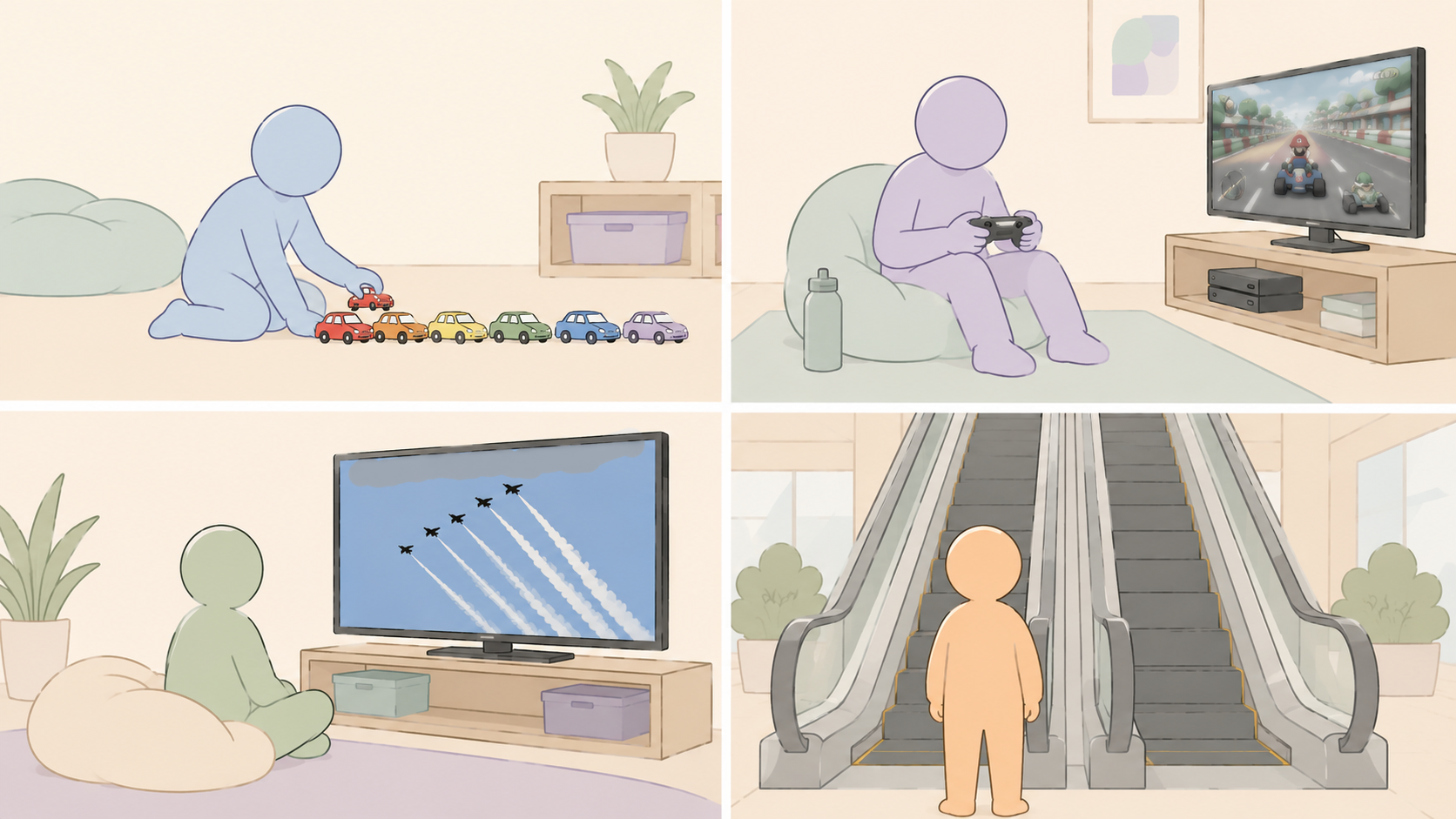
A child returns to the same three songs. Talks about trains through every conversation. Memorizes television episodes, studies maps, focuses on video games, sorts figures, or watches the same short video again and again.
Adults often notice the repetition first. We may worry that the interest is taking up too much space. We may try to broaden the child’s play, redirect the conversation, or use access to the interest as a reward for completing something else.
The phrase intense enthusiasm is used as an alternative to deficit-framed terms such as restricted or fixated interest. Many autistic people also use and value the term special interest, and a person’s own language should be respected.
Whatever words we use, repetition is only what we can see from the outside.
From the inside, an intense enthusiasm may be pleasure, expertise, predictability, identity, communication, or regulation. It may be the place where attention feels organized and fully the person’s own.
When we focus on making the interest smaller, we can miss what it is already making possible.
When the Enthusiasm Already Holds the Words
I once worked with a nonspeaking preschooler whose intense enthusiasm was Daniel Tiger’s Neighborhood. He knew the show inside and out.
One day, I asked him:
“Where’s your mom going?”
He did not answer using the symbols on his AAC system. Instead, he opened YouTube and found the exact moment in a Daniel Tiger episode when Daniel tells his mother, “I’m gonna miss you.”
I understood that as his answer.
He had gone to the place where the language already lived—the words, scenes, and relationships he knew deeply—and handed that language to me.
I did not teach him those words. His enthusiasm had already given him access to them.
What needed to expand in that moment was not his way of communicating. It was my understanding of where meaningful communication could come from.
Adults may hear familiar character lines, song lyrics, repeated phrases, or video clips as scripting or borrowed language. But borrowed language can still carry original meaning.
The language may have come from somewhere else.
The meaning belongs to the child using it now.
What Becomes Possible Inside an Intense Enthusiasm
An autistic child does not have to prove that an interest is educational or therapeutic for it to deserve respect. Children are allowed to love things simply because they love them.
At the same time, important things often happen inside these interests.
A familiar topic can reduce uncertainty. Repetition can lower cognitive demand. Known words, images, sequences, or rules may provide something steady when the surrounding environment feels difficult to interpret.
An intense enthusiasm may create access to language, memory, imagination, problem-solving, and connection—not because an adult has turned it into a lesson, but because meaningful attention is already doing important work.
It can also be a place of competence.
Autistic children spend a great deal of time in situations where adults choose the topic, set the pace, ask the questions, and decide what counts as a correct response. Inside an intense enthusiasm, the child may know more than everyone else in the room.
That experience matters.
We do not need to assign a developmental purpose to everything a child loves. But we should notice what becomes possible when the person has access to it.
Do they communicate more freely? Does their body settle? Do they recover after a demanding part of the day? Do they invite someone else into the experience? Do they experience themselves as capable and knowledgeable?
The enthusiasm may not be getting in the way of learning.
It may be where learning, connection, and regulation are already happening.
Deep Focus Can Make Shifting Hard
Respecting an intense enthusiasm does not mean pretending that transitions away from it are easy.
When attention is deeply organized around an interest, disengaging may require significant cognitive and nervous-system effort. The person must stop something absorbing and predictable, release the place they are holding in it, and reorganize their attention around something else.
What adults experience as refusal may sometimes be the visible part of that effort.
This does not mean transitions can always be avoided. Children still need to leave for school, come to the table, go to sleep, share devices, and move through the rest of their day.
But difficulty shifting is not proof that the enthusiasm itself is unhealthy.
Restricting access may even create more urgency. If a child does not know when—or whether—they will be allowed to return, stopping can feel more threatening.
Support might include preserving the person’s place, giving meaningful notice, or making return predictable:
“We need to leave in ten minutes. You can finish this section first.”
“Let’s save the video so you know where to find it later.”
“The figures will still be here when you come back.”
A Note for Parents
You may be thinking: You have no idea. We have already tried all of that. It does not work.
You may already have tried timers, warnings, visual schedules, choices, calm language, and carefully planned transitions. Your child may still become intensely distressed.
There is no perfect phrase that makes a difficult transition easy. Respectful language is not a trick for producing cooperation.
A child can still be deeply upset. A parent can still need to hold the limit. The transition can still be hard for everyone.
The purpose of respectful language is to hold a necessary boundary without adding the message that the child’s enthusiasm is excessive, embarrassing, or wrong.
The goal is not a smooth performance.
It is to support the shift without shaming the thing that matters.
Respect Does Not Mean No Boundaries
Supporting an intense enthusiasm does not mean every activity is available at every moment.
Bodies need sleep, food, movement, bathroom access, and medical care. Families and classrooms share time, space, devices, materials, and attention. Some activities cannot happen safely in a particular setting.
Real boundaries still exist.
The difference is whether the boundary is connected to an actual need or whether the interest is being restricted simply because an adult thinks it is too intense, repetitive, unusual, or unproductive.
“The tablet needs to charge. You can use it again after dinner.”
That is different from:
“You’ve talked about that enough.”
The first sets a limit while preserving the value of the interest. The second makes the enthusiasm itself the problem.
The goal is not unlimited access. It is access that is predictable, respectful, and not made contingent on unrelated compliance.
Working With an Intense Enthusiasm
- Let it lead sometimes. Follow the interest’s logic instead of immediately deciding where it should go. Joining does not require taking over or turning it into a lesson.
- Listen for communication. Character lines, technical terms, song lyrics, maps, and repeated scripts are real language. Ask what they may be communicating in this moment.
- Use it during hard moments without shame. If returning to an interest helps a person recover after overwhelm, that is useful information.
- Support the shift without devaluing the interest. Give notice, preserve the person’s place, and make return predictable when possible. These supports may not prevent distress, but they can reduce uncertainty and protect dignity.
- Let enjoyment be enough. An intense enthusiasm should not have to produce measurable progress every time.
Looking for resources that support autistic learners through understanding, co-regulation, and shared meaning—not pressure or compliance?
What This Has to Do With Co-Creation
The same principle guides the resources we build at Shared Stories Studio.
The learner’s language, pace, body, interests, and interpretations are not barriers to work around. They are the starting material.
Co-creation does not mean placing a favorite character on an adult-created lesson so the learner will tolerate it. It means allowing what the learner brings to change the direction of the interaction.
An intense enthusiasm may show us what feels predictable, which words already carry meaning, how the person organizes information, what kind of connection feels possible, and where competence and joy live.
When we treat the enthusiasm only as something to broaden, limit, or move beyond, we may be shrinking much more than a topic.
We may be shrinking a source of language, regulation, expertise, identity, and connection.
When an autistic learner returns to the same subject again and again, the first question does not need to be:
“How do we get them interested in something else?”
We can begin somewhere more useful:
What becomes possible for this person here—and what support will help when it is time to shift?
Then support the transition without treating what they love as the problem.