
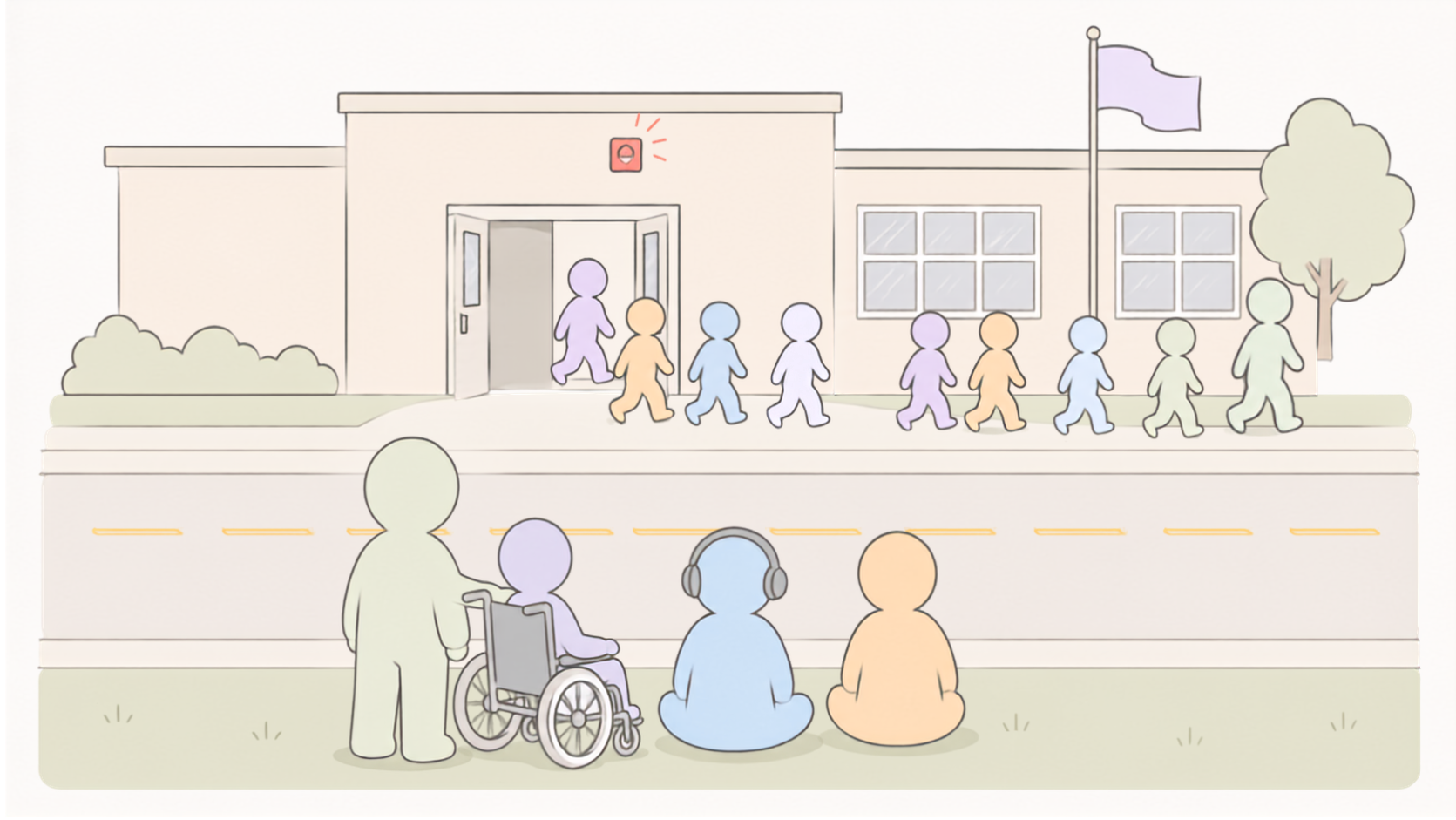
Most schools hold a fire drill during the first month of the year.
Administrators plan it. They know the date and the time. In theory, nobody else does, because part of the point is to practice what to do when an alarm is unexpected.
That is often not how it goes.
The administration wants the drill completed quickly. Everyone outside, at the designated spot, every student accounted for.
Beat the clock. Check the box.
What happens before the alarm
I have watched the next part more than once.
The special education department gets a heads-up.
There are understandable reasons for this. Some students need additional support because of mobility, sensory access, communication, cognitive processing, or regulation needs.
A student who uses a wheelchair may need additional staff or an alternate evacuation route. A student who is blind may need support navigating a suddenly crowded hallway. A Deaf or hard-of-hearing student may need accessible alerting. A student with cognitive disabilities may need more processing time. An autistic student may experience the alarm as physically overwhelming.
Those are real access needs.
The problem begins when advance notice is used not to prepare the team, but to rearrange the conditions before the drill begins.
A student may be moved closer to an exit.
Additional staff may gather in advance.
Some autistic students may be taken outside before the alarm sounds.
Other students may be excused from participating altogether.
I have stood outside with those students, on the grass, waiting for the rest of the school to come out.
At the time, it looked like care.
We had prevented the distress.
We had also prevented the practice.
If the student is already near the exit, we do not learn whether the evacuation route works from the cafeteria, bathroom, therapy room, or second floor.
If the needed adults are already assembled, we do not learn whether those adults are actually available without warning.
If a Deaf student has someone standing beside them when the alarm sounds, we may not learn whether the alert itself is accessible.
If an autistic student is already outside, we do not learn what happens when a painfully loud alarm interrupts an ordinary class, and the whole building begins to move.
Advance notice may make the drill faster and less distressing.
It can also remove the exact conditions the safety plan most needs to address.
A drill can meet the time goal and still miss the point
For administrators, the goal may be very concrete: get everyone out of the building, to the designated location, accounted for, and do it within the required time.
That goal matters.
A school needs to know whether hundreds of people can move out of a building quickly.
But the stopwatch answers only one question:
How long did this evacuation take under these conditions?
It cannot tell us whether every student’s safety plan actually worked.
A drill may look excellent because several students were already outside. It may run smoothly because additional staff had time to assemble. The school may beat its evacuation time.
But the students standing on the grass with me were, by any reasonable measure, some of the students whose plans most needed testing.
And theirs were the plans nobody learned anything about.
A successful drill should tell us more than whether the building emptied quickly.
It should help us learn whether the plan works when an ordinary school day suddenly becomes an evacuation.
Now imagine a real fire.
Preparation is not pre-positioning
The answer is not to stop preparing students or staff.
It is to prepare earlier.
For a team, there is one question that helps separate preparation from pre-positioning:
Could we carry out this plan if nobody had twenty minutes to get ready first?
A mobility team can review routes, staffing, and equipment before the drill. Staff supporting a blind student can consider what happens when hallways are crowded. A team supporting a Deaf student can make sure alerting is actually accessible. Adults supporting an autistic learner can make sure noise protection or other sensory supports are where the learner actually is, not stored in a bin in the resource room.
That is preparation. Moving people, equipment, and staff into ideal positions immediately before the alarm is something else.
Preparation builds the plan.
Pre-positioning changes the conditions the plan is supposed to handle.
For autistic learners, there is another piece.
A warning and preparation are not the same thing.
Sometimes knowing twenty minutes ahead helps. Sometimes it creates twenty minutes of anticipatory anxiety. One learner may want to know first thing in the morning. Another may do better knowing shortly beforehand. Another may not want advance notice at all.
But the morning of the drill should not be the first time anyone has talked about what a fire drill is.
Preparation happens earlier, on an ordinary day when nothing is about to happen.
It might sound like:
Sometimes at school, an alarm goes off. It is very loud. It might be a fire drill. Adults lead the safety plan. I can cover my ears. We go outside together. Then we come back.
There is no demand attached to those words.
Nothing is about to happen.
You can explore the event instead of managing it.
Look at the sequence. Talk about the alarm. Notice which parts might be difficult. Find out whether the learner wants noise protection, proximity to a particular adult, less talking afterward, or something nobody thought to ask about.
For an AAC user, this is also when adults have time to make relevant language available before it is needed.
And first-person language matters here.
Not just:
You will hear a loud alarm.
But:
I hear a loud alarm. It may feel too loud. I can cover my ears. An adult helps me.
That language can become the learner’s language. Or the learner can reject it.
It doesn’t just feel loud. It hurts.
I need my headphones.
Don’t talk to me afterward.
The goal is not to hand the learner a script.
The goal is to create enough time and space for the learner to understand what may happen and, when possible, add what is true for them.
Then leave it alone.
Preparation is not rehearsing calm.
It is building enough familiarity that the drill is not the learner’s first encounter with the sound, the interruption, why everyone is moving, where they are going, who is leading, and what happens next.
Preparation does not make the alarm tolerable
There is an important objection to all of this.
We prepared. The alarm went off anyway, and it was still terrible.
Yes.
Preparation does not make a fire alarm tolerable.
For some autistic learners, the alarm is genuinely painful. Nothing we do in August changes its volume or sudden onset. A learner may know exactly what is happening and still cry, freeze, cover their ears, move toward a trusted adult, or need substantial support.
That does not mean preparation failed. Without preparation, a learner may be experiencing overwhelming sensory input while also having no idea whether there is danger, why everyone is suddenly moving, where they are going, or what happens next.
With preparation, the sensory experience may still be overwhelming. But it is an experience they recognize.
The distress may look the same from the outside. It may not be the same on the inside.
If we judge preparation only by whether a learner stops becoming distressed by the alarm, we are measuring it for something it was never supposed to do.
The goal was never to make the learner look calm.
The goal was to make the experience more understandable and the safety plan more usable.
Broaden the list past the first day
Standing outside on that grass changed my perception of back-to-school preparation.
We spend a lot of time preparing children for the first day: the teacher, the classroom, the bus, the schedule, the lunchroom.
Those things matter.
But then school begins.
And ordinary institutional events start arriving.
The fire drill.
The lockdown drill.
The substitute teacher.
The assembly that changes the schedule.
Picture day that rearranges the morning.
An early dismissal.
None of these has to become a crisis. But any of them can dismantle a set of expectations a learner has been working hard to build.
We cannot prepare children for everything. I do not think we should try.
But perhaps our preparation list can be a little wider than the first day.
And perhaps it can include one honest truth:
School changes.
Sometimes we know the change is coming.
Sometimes we do not.
The goal is not to make every possible change predictable.
It is to build enough shared understanding that when something changes, the learner is not starting from zero.
Where this lands
The question I often hear in August is:
How are we going to get this student through the first fire drill?
I think that question comes too late.
A better question is:
What will this student — and the adults responsible for supporting them — already know before the alarm sounds?
Will the student have some understanding of what the sound means and what happens next?
Will the adults know what the student’s body may do when the alarm begins?
Will communication and sensory supports actually be available?
Will the evacuation plan work from wherever the student happens to be?
Will the adults who are supposed to help know their roles without time to assemble first?
That is preparation.
It happens before the stopwatch starts.
It happens on an ordinary day when nobody is standing by the alarm.
Begin in August.
I build Shared Stories Studio resources around the situations learners actually encounter, beginning with regulation and using first-person language throughout so that learners and the people who know them can bring in what is already true.
The First Six Weeks brings together five situations that can disrupt predictability early in the school year: fire drills, lockdowns, emergencies, substitute teachers, and routine school changes.
Each series includes Levels A, B, and C and is designed to be explored on an ordinary day — not handed to a learner for the first time when the event is already happening.