
Over the years, I have heard parents, teachers, and therapists say:
“We tried AAC, but she just threw it.”
“I show him which picture to choose, but he pushes my hand away.”
“He has the AAC device, but he says the same thing over and over and over.”
These moments can be deeply discouraging. Families may have waited months for a device. Teachers may have learned unfamiliar software, added vocabulary, and worked to keep the system nearby.
Then the child pushes it away, closes the app, throws it, or selects the same word again and again. It is understandable to wonder: Is this the wrong system? Is the child not ready?
In many AAC conversations, teams have focused on vocabulary, motor planning, sensory access, positioning, and system fit. Those questions matter. But in my own training and practice, we asked another question far less often: Could the AAC system—or the expectation to use it—have become a demand?
Could AAC Use Become a Demand?
AAC is meant to increase access to communication. But the experience of using AAC is shaped by what happens around the system.
For some autistic communicators, the device may appear most often when an adult wants something from them:
“What do you want?”
“Tell me which one.”
“Say, ‘I want crackers.’”
“Use your device.”
The expected answer may already be known. An item may be held back until the message is produced. An adult may point to the word, repeat the question, or guide the communicator’s hand.
The device has stopped being only a way to access language. It has also become a signal that a demand is coming.
Until recently, we rarely examined AAC refusal through the lens of demand avoidance or threatened autonomy. We asked: How do we increase device use? What prompt comes next?
We asked less often: What happens when communication becomes an expectation? Can the learner refuse, disagree, change the subject, or say nothing?
For some autistic people, an externally controlled or difficult-to-escape expectation can create a strong threat response. Some people and families understand this through the lens of PDA, often described as a persistent drive for autonomy.
AAC refusal alone does not mean someone has a PDA profile. One behavior should not be used to diagnose or categorize a person. But demand avoidance may still be useful to consider—especially when a communicator can use the system but resists it most strongly when use is expected or controlled.
A learner may understand the symbol, know how to activate it, and even want the item. Once the adult says, “Use your device,” they may no longer be able to produce the expected response.
The adult sees: They know how. They are choosing not to.
The learner’s nervous system may be experiencing: I cannot do this while you are making me do it.
Then more prompting may create more pressure, not more communication.
Before Concluding That the Person Is Refusing AAC
Consider:
- What happened immediately before the device was pushed away?
- Had the person already communicated through speech, gesture, movement, or gaze?
- Was the expected message chosen by the communicator or by the adult?
- Could the system express what the person actually wanted to say?
- Was the device physically and cognitively accessible in that moment?
- Did touching the device lead to more questions, prompting, or work?
- Might the person be refusing the interaction rather than the communication system?
When the Device Starts to Feel Like a Test
Most adults are doing what they have been taught. They may worry that accepting a gesture, movement, or spoken approximation will discourage AAC.
But communication is not more meaningful because it came through a device. And a message is not self-directed when someone else has already decided what the communicator should say.
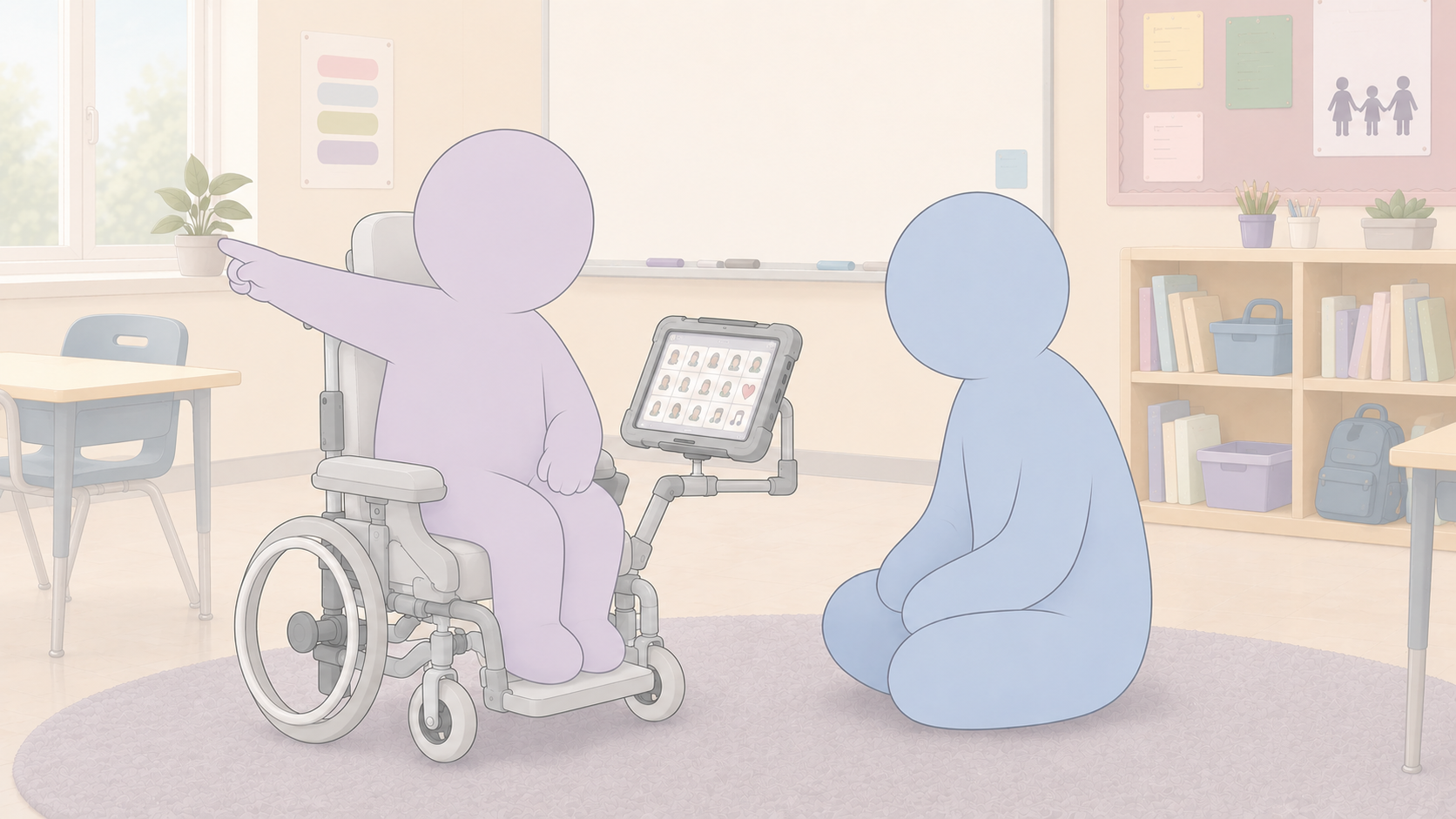
Imagine an adult places two pictures in front of a child and asks, “Which one do you want?” The child reaches toward one. The adult redirects the child’s hand: “Show me on your pictures.” The child pushes the hand away.
From the adult’s perspective, the child has refused AAC. But the child reached, then pushed a hand away. Both actions communicated: I already showed you. Do not move my hand. Stop.
The message did not arrive through the expected method, but communication was still happening.
AAC is part of a person’s communication, not a replacement for every other way they communicate. A person may use speech, gesture, movement, writing, signs, an AAC system, or several together. The most accessible method may change from moment to moment.
Not Every Refusal Is Demand Avoidance
Demand avoidance is one possibility, not the explanation for every refusal.
A person may disengage because needed vocabulary is unavailable, access demands are too high, or the device is difficult to use in that environment.
They may be tired, overwhelmed, unwell, or in pain. Another method may be easier. They may not understand the question or want to answer. The device may have become associated with testing or work.
Sometimes the person is refusing the interaction or a message chosen for them. Sometimes they are protecting their body, attention, privacy, or autonomy. Sometimes we do not yet know.
The point is not to replace one quick conclusion—“AAC does not work”—with another—“this is demand avoidance.” The point is to widen our thinking.
What happened immediately before the refusal? Was the person already communicating another way? Did touching the device lead to more questions or demands? Could the system say what they actually wanted to say?
“He Keeps Saying the Same Thing”
Years ago, I worked with a young child who was starting to use AAC. One day, his mother asked what he thought they might have for Shabbat dinner at his Jewish grandparents’ house.
He navigated through his system on his own and selected a word he was never formally shown: pork chop.
Then he laughed.
For days afterward, he returned to the device, selected pork chop, and laughed again.
He was not stuck on a word. He was telling a joke.
The humor depended on remembering the conversation, understanding something about his grandparents, choosing an unexpected answer, and waiting for another person to recognize it. The repetition was not meaningless. It was shared history.
Adults often worry when an AAC user repeatedly selects the same word or phrase. Repetition may be exploration, regulation, enjoyment, a familiar script, an attempt to connect, or a message we have not yet understood.
Speaking children repeat favorite jokes and phrases too. We do not assume that speech has failed because adults do not immediately understand why the repetition matters.
We can acknowledge what we hear without correcting it: “You said ‘pork chop’ again.” “You remembered that joke.” “That still makes you laugh.”
We will not always discover the meaning as clearly as we did that day. But the possibility should make us slower to dismiss repeated AAC as random or wrong.
Sometimes the communicator knows exactly what they are saying.
We are the ones who have not understood yet.
From Prompts to Invitations
Reducing pressure does not mean removing the device or stopping modeling. It means changing the interaction around it.
Instead of repeated questions, we can comment. Instead of pointing to what the person should say, we can model language without requiring imitation. Instead of saying, “Use your device,” we can keep it accessible and respond to communication in all its forms.
We may also need to examine what we communicate when we model AAC. Adults often speak a complete sentence while briefly touching one or two symbols, then expect the learner to respond through the device. We intend both modes to carry meaning. But the interaction may still suggest that speech is the adult’s real communication, while AAC is the learner’s task.
Modeling is not only about touching symbols. It is also about treating the AAC message as language worth attending to.
We might model naturally: “You want more.” “This is hard to open.” “You are telling me no.” Then we pause.
Invitational modeling asks adults to observe carefully, wait longer, and tolerate not controlling the response.
When Goals Turn Communication Into a Quota
A goal such as “The student will use the AAC device to request a preferred item five times during a session” is measurable. But it may tell us only that the device was activated five times—not whether the messages were self-directed or meaningful.
A frequency count can be one useful data point. But five device activations do not tell us whether the messages were spontaneous, self-directed, meaningful, or produced under prompting. When the number becomes the primary goal, adults may arrange repeated opportunities and prompt requests until the quota is reached.
Better AAC goals examine access, autonomy, communicative functions, partner support, and whether the person can use the most available method in that moment.
Can they protest, comment, ask questions, disagree, joke, set boundaries, and say no? Can they use another method when it is more accessible? Can they choose not to communicate?
AAC goals should protect access and expand possibilities, not make device use the price of participation.
The Device Is Not the Goal
The goal of AAC is not successful device use. The goal is communication access.
Sometimes communication will happen through the device. Sometimes it will happen through a glance, movement, repeated phrase, pushed-away hand, or a body moving toward the door.
Our job is not to make every message look the way we expected. Our job is to notice what is already being communicated, make more language available, reduce unnecessary pressure, and remain open to what the person may be telling us.
AAC access is not AAC compliance.
And when the device is refused, communication has not necessarily stopped.
We may need to listen differently.
Looking for Practical, Neuro-Affirming Resources?
Shared Stories Studio creates regulation-first resources that support body awareness, communication, and self-advocacy without turning participation into compliance.
Explore the Shared Stories Studio store on Teachers Pay Teachers.
Further Reading
Augmentative and Alternative Communication (AAC)
National Joint Committee for the Communication Needs of Persons With Severe Disabilities (NJC)
PDA Society – Pathological Demand Avoidance