
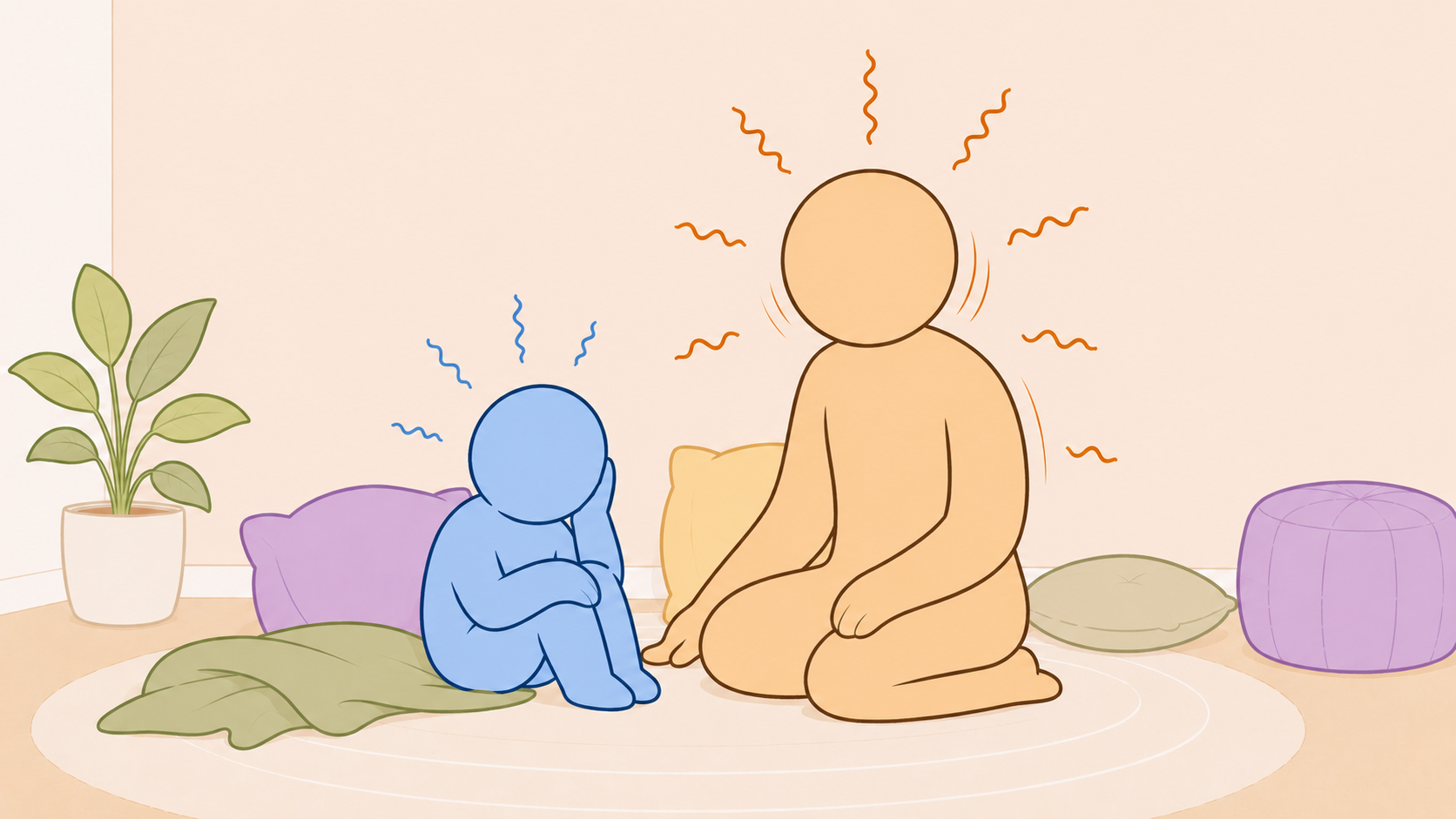
You have probably noticed this.
Your child is melting down, shutting down, running, screaming, pacing, or completely frozen. You want to help. You start talking, redirecting, offering choices, explaining, trying to make it better.
And sometimes, the more urgently you try to help, the harder the moment becomes.
That does not mean you are doing anything wrong. It means there are two nervous systems in the room.
This is not about preparing for an appointment, a new environment, or a hard conversation ahead of time. This is about the moment your child is already overwhelmed—and your own body is trying to catch up.
On the days when you can find even a little steadiness in yourself, the moment may feel different. Your child may have one less source of urgency to manage. Connection may become easier to find again.
Not because you fixed everything. Not because you stayed perfectly calm.
But because your presence offered something a little less rushed while your child moved through something hard.
What May Be Happening
When a child is overwhelmed, their body may shift into a protective response.
Their body may get loud, fast, still, tense, avoidant, tearful, or hard to reach. Their thinking may become less flexible. Language may be harder to access. Small demands may suddenly feel impossible.
This is not necessarily a behavior choice. It is often a body doing its best to respond to something that feels too big, too fast, too uncertain, too uncomfortable, or too demanding.
For autistic children, overwhelm may build quickly when sensory input, uncertainty, communication demands, physical discomfort, fatigue, social pressure, or expectations begin to stack up. Recovery can take time.
That is not a character flaw. It is a nervous system doing its job.
The Part Families Are Rarely Told
Our bodies affect one another.
Children may notice changes in our pace, facial expression, movement, tone, or urgency before either of us has found words for what is happening.
When you are tense, bracing, scared, or trying very hard to make the moment stop, your child may feel some of that intensity too. Not because they are reading your mind. Not because you have failed them.
Bodies are always taking in information from the people nearby.
A rushed voice, a tight jaw, fast movements, repeated questions, or a sense that something needs to end immediately can sometimes add more intensity to a moment that already feels too big.
Your urgency makes sense. You love your child. You may be worried about safety, other people watching, what happens next, how long this will last, or whether you are missing something important.
Your nervous system is responding too.
Getting Grounded Does Not Mean Being Perfectly Calm
The first step is not always a strategy aimed at your child.
Sometimes it is finding enough steadiness in yourself to stay connected without adding more urgency to the moment.
That might look like this:
Let your exhale get a little longer. You do not need a special breathing technique. Just notice your breath and allow the out-breath to be a little slower than the in-breath.
Notice where you are bracing. Your shoulders may be tight. Your jaw may be clenched. Your hands may be moving quickly. You may not feel relaxed, but noticing where you are holding tension can give your body a little more room to soften.
Slow your pace. You do not need to become quiet, gentle, or perfectly composed on command. But you may be able to use fewer words, move more slowly, or pause before offering the next idea.
Name what is happening inside you. You might silently say, “I am scared.” “I am frustrated.” “I do not know what to do right now.”
Naming your experience does not make it disappear. It can help you make room for it, rather than letting it lead the whole moment.
Remind yourself that this moment will not last forever. When a child is overwhelmed, the moment can feel endless. Your own body may start searching for the fastest way to make it stop.
But this moment will end.
You do not have to know exactly when. You do not have to solve every part of it right now. You may only need to stay close enough to safety, connection, and the next small step.
A flooded nervous system rarely responds well to more explaining, more questions, or faster problem-solving. Sometimes the most helpful thing is not making the moment end immediately. It is helping the moment feel less alone while it is here.
This is part of self-regulation. It is not having no feelings, hiding them perfectly, or becoming a calm machine for your child.
It is making room for your own feelings while choosing what may help the room feel safer and less urgent.
Once You Have a Little More Steadiness
Once you have found even a partial foothold, something else becomes possible.
You may stop trying to talk your child out of what they are feeling. You may stop troubleshooting every second. You may become more available to notice what they need.
Sometimes that looks like:
- Being nearby without demanding eye contact, language, acknowledgment, or a quick recovery.
- Using fewer words.
- Stepping back from demands for a while.
- Offering familiar sensory support, movement, water, quiet, a predictable rhythm, or a trusted object.
- Giving more space when space is what your child’s body seems to need.
A child who is quiet, turned away, curled up, pacing, hiding, absorbed in something familiar, or not ready to talk may be finding their own way toward steadiness.
Connection does not always look like talking, eye contact, or immediate comfort.
Being with your child may mean moving closer. It may also mean staying available without moving in.
Looking for supports that begin with body signals, shared regulation, and understanding—not pressure or compliance?
Co-Regulation Is Not a Technique
There is a name for this kind of shared support: co-regulation.
Co-regulation is the way one person’s presence can help another person feel safer, steadier, or less alone.
But it is not a technique you perform correctly. It is not a way to make a child regulate faster. It is not a test of whether you are calm enough.
It is a relationship.
It can look like:
- Sitting nearby.
- Waiting.
- Offering your hand and accepting “no.”
- Lowering demands.
- Saying very little.
- Helping with safety while still protecting dignity.
Your steadiness may not end the hard moment. But it can help make the room feel less frightening, less pressured, and less lonely while your child moves through it.
And when your own urgency rises, you might remind yourself:
This moment will not last forever. It will end.
You do not have to force the ending. You only have to help hold the space until it comes.
Why This Can Matter for Autistic Children
For many autistic children and teens, the world can ask a great deal of the nervous system.
Sensory input, uncertainty, communication effort, physical discomfort, rapid transitions, social pressure, and unclear expectations can all stack up.
In those moments, an adult’s pace, tone, and willingness to reduce pressure can matter a great deal.
That does not mean autistic children need adults to make every hard feeling disappear. It means support may need to be more available, more flexible, and less focused on getting back to “normal” quickly.
A child may need more time. They may need more space. They may need an adult who understands that quiet does not always mean refusal, movement does not always mean defiance, and strong energy does not always mean someone is choosing to make things hard.
Support is not about making the child look calm. It is about helping them have access to safety, connection, and recovery in the way their body can receive it.
One More Thing: You Matter Too
If you are exhausted, hypervigilant, overwhelmed, carrying advocacy work, managing appointments, anticipating the next hard moment, or trying to hold everything together, finding steadiness in the middle of a crisis may be genuinely hard.
That is not a personal failure. That is what sustained stress does to a nervous system.
You deserve support too.
Not only because it may help you be more available to your child. Not only because it may make hard moments easier.
But because your nervous system matters on its own terms.
Related Support for Calm Moments
Shared Stories Studio resources are built around the idea that regulation comes before language, learning, reflection, or problem-solving.
They are designed to be used during calm moments, alongside relationship and shared understanding—not as tools to hand to a child during distress or as a way to make difficult feelings disappear.
When behavior becomes intense, the first question is often not, “How do I stop this?”
It may be:
“What might be happening underneath?”
A Free Guide for Hard Moments
When behavior escalates, something is usually happening underneath.
Get the free guide, When Behavior Escalates, Something Is Happening Underneath, for a regulation-first starting point when an autistic or neurodivergent child is overwhelmed, shut down, moving fast, or hard to reach.
Sign up below and I’ll send it to your inbox.
Get the Free Guide and Notes from the Studio
You’ll receive the free guide first, followed by occasional practical notes on regulation-first, neurodiversity-affirming support.