
When we talk about supporting autistic learners with change, we often focus on preparing them for what will happen next. Catching change starts somewhere slightly different.
Years ago, I developed and ran a summer day camp for autistic campers, along with their siblings and friends. At the time, I did not have a word for the idea behind it. Now I understand that the word was “neuro-affirming.”
It was a place to be together with very little demand attached. A place to explore interest, play with friends – or not. About half of the counselors were autistic adolescents.
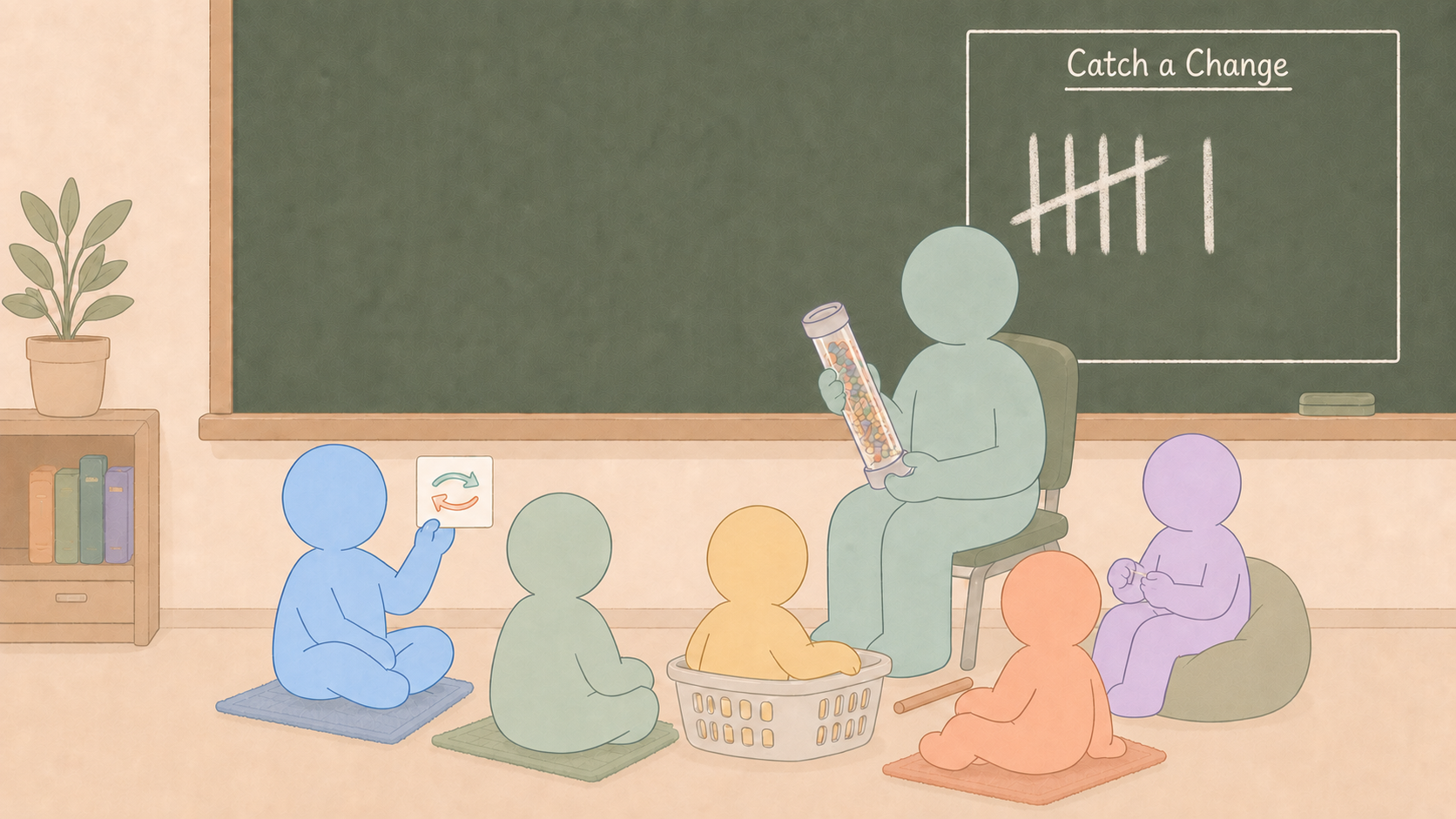
Morning meeting began with two parts. First, we spent a few minutes catching changes. More about that in a bit. Then we moved into sharing time, which we did with a talking stick—a plain wooden rod, about ten inches long, with a red feather on top.
One morning, I brought in a replacement: a clear plastic rain stick, bigger and considerably more interesting than the wooden rod.
I remember feeling rather pleased with myself. The old stick was worn. The new one looked better. It made a better sound. From my perspective, this was an improvement.
“Look at our new fancy talking stick.”
One of the campers noticed immediately.
She signed an approximation of the sign for “change.”
She caught the change.
She wasn’t interested in whether the new rain stick was better. She was interested in the fact that it was not the same one.
And I did what adults so often do when we think we’ve made a positive change. I explained why it was better. The old one was boring. This one looks cooler. We were still going to use it the same way. Nothing important had really changed.
I had not marked the change. I had sold it.
That distinction has stayed with me.
Except, of course, something had changed.
She caught it.
What if we simply caught the change?
“The rain stick is different today.”
Or even:
“That’s a change.”
That’s what I mean by catching change.
Something usually is one way. Something is different now. We notice the difference and make it accessible to the learner.
Then we let the information stand.
“His hair is shorter today. That’s a change.”
“Look, the road is closed. We need to change directions.”
“Your blue cup is in the dishwasher. Today might use a green cup. That’s a change.”
The marker might be the spoken word change, a picture symbol, an AAC word, a visual added to a schedule, a written word, a sign, or a familiar gesture. For some learners it may be helpful to have something permanent they can return to, as well as a quick way to mark a change in the moment. The form can vary. The message is the same: Something is different, and I noticed it too.
Why “change”?
I chose the word change rather than different deliberately. Different describes a comparison. Change marks a shift—something was one way, and now it isn’t.
It can be tiny or significant, welcome or unwelcome, expected or surprising. The point of catching a change isn’t deciding whether the new thing is better or worse. It is simply noticing: something changed.
And once we notice change without judging it, change itself becomes a little more visible—and perhaps a little less mysterious.
Why mark something the learner may already have noticed?
Because noticing that something is different and having a shared way to make sense of that difference are not the same thing.
And because adults tend to move very quickly past the information itself and into managing what we think the learner should do with it.
We have a habit of adding something to the change.
When something changes:
- we reassure: “Don’t worry. Everything else will be the same.”
- we warn: “Remember, we’re going to have a substitute today.”
- we minimize: “It’s not a big deal.”
- or we sell: “This is going to be fun!”
Sometimes those things are useful. Some changes need advance preparation. Reassurance can help. And sometimes the new thing really is fun.
But each adds our interpretation. We’ve decided the change is difficult, minor, manageable, exciting, or not worth worrying about.
Catching change starts one step earlier.
This was expected. This is what happened. They are different.
The camper at camp didn’t need me to explain why the rain stick was better.
“Cooler” was my judgment.
She noticed different.
I wish I had started there.
Change Happens
“Change happens” was something we said frequently at camp.
It was simple, but there was something important underneath it. We weren’t promising that everything would stay the same. It couldn’t.
- People are absent.
- Plans get canceled.
- The bus is late.
- Someone sits in a different chair.
- Someone gets new glasses.
- The talking stick becomes a rain stick.
Some of these changes barely register for the adults involved.
But “minor” is an adult judgment.
We talk a great deal about predictability when supporting autistic learners, and for good reason. But predictability doesn’t have to mean keeping everything the same. It can also mean having a reliable way to notice when something isn’t the same.
Something changed. Someone saw it. There is language for it.
Change happens. We can catch it.
That doesn’t necessarily make the change easier.
It makes the change clear.
And I think clarity is an underused form of support.
Careful. A support can become another demand.
There is a catch here.
Once adults find a potentially useful support, we have a remarkable tendency to turn it into a task.
We introduce a change symbol. Then we ask the learner to point to it.
We show the schedule. Then we ask, “What’s different?”
We model the word on AAC. Then we wait for the learner to say it too.
We mark the change. Then we ask, “Are you okay with that?”
Pretty quickly, an idea that began as a way to provide information becomes something the learner is expected to respond to correctly.
A support that requires a response is a demand wearing a helpful expression.
A support that requires a response is a demand wearing a helpful expression. That does not mean we should never invite participation. A learner may want to comment, protest, ask a question, move a symbol, sign change, or tell us what they noticed.
Those responses can give us important information.
But they don’t have to be the price of receiving the support.
If I say, “His hair is shorter today. That’s a change,” I can stop there.
The learner doesn’t have to prove they heard me.
They don’t have to identify what changed.
They don’t have to say it is okay.
They certainly don’t have to appear calm.
We can make information available without requiring the learner to perform understanding for us.
Sometimes that is the support.
Catch the ordinary changes too
Adults are most likely to announce change when we anticipate difficulty.
“No playground today.”
“Your teacher is absent.”
“Speech is at a different time.”
“There’s going to be a fire drill.”
If a change symbol, spoken phrase, AAC message, or gesture appears only before things adults expect to be difficult, we may accidentally teach a very specific meaning: that change means bad news is coming.
That’s why I think it matters to catch ordinary—and even welcome—changes too.
We are having a pizza party on Friday.
The class has strawberries instead of apples.
The chairs are arranged differently.
Someone got a haircut.
Someone gets new glasses.
These changes don’t need a coping strategy.
Nothing needs to be fixed.
We can simply notice.
“That’s different.”
“That changed.”
Over time, the concept becomes broader and more accurate: change is ordinary. It can matter a little or a lot. Different changes can affect the same person very differently.
That’s a much richer concept than “change is okay.”
Catch the Change
This is where the idea of Catch the Change comes from.
Adults notice changes that occur naturally during the day and mark them using language accessible to the learner.
At first, the adult may do most—or all—of the catching.
I think that’s important.
Noticing change should not become another job the learner has to perform.
The point isn’t to quiz:
“What changed?”
“Do you remember what was supposed to happen?”
“Show me the change.”
The point is to create shared language for differences that are already happening.
As the idea becomes familiar, learners may begin catching changes themselves. A class or group might even collect them together:
“We caught eight changes today.”
The count isn’t a score. No one passes Catch the Change. The interest is in noticing how often life differs, sometimes in tiny ways, from what we expected.
You could introduce the idea with a few harmless arranged changes—a different pencil, a chair moved to another spot, a book on the opposite side of the table.
But I wouldn’t keep it there.
If it never leaves circle time, what you have built is a circle time activity.
The interesting part begins when the idea follows the learner into ordinary life, where changes are natural and sometimes unexpected.
A spoken word or sign may be enough in the moment. Another learner may benefit from a change symbol that remains on a visual schedule. An AAC user may use change, different, wrong, not that, or what happened?
There isn’t one correct marker.
The point isn’t to teach a particular symbol.
The point is to make the concept accessible and useful.
This isn’t really about tolerating change
The endpoint isn’t: “I learned to tolerate changes.”
It isn’t even: “I learned that change is okay.”
Some change isn’t okay. Some is disappointing. Some is frightening. Some creates a sensory or communication access problem. Some requires more processing time. Some is welcome. Some barely matters.
Once change becomes something we can notice and name, we can begin learning something much more useful: Which changes matter to this person?
A learner might eventually tell us:
“I don’t care if the schedule changes, but I need to know who will be there
“Substitute teachers are hard because they don’t know how I communicate.”
“I thought we were going outside, and I’m disappointed that we’re not.”
“I need more warning for that.”
“That change doesn’t bother me.”
Now we aren’t measuring flexibility. We’re gaining information that can support self-advocacy. The goal shifts from teaching the learner to accept changes to helping the learner understand their own responses and communicate what they need.
That’s a very different goal.
A learner cannot report what their system does not let them say.
When the only evidence we have that a change mattered is behavior adults describe as “resistance,” we may miss a much more precise message:
I noticed.
This is different.
You didn’t tell me.
I thought the new rain stick was better
I still think about that camper.
I can’t tell you what the old talking stick meant to her. I don’t know whether its replacement was frustrating, surprising, interesting, or simply very noticeable.
That’s part of the point.
My judgment that morning was that a better talking stick was good news.
Her observation was simpler.
It was different.
I didn’t need to convince her that my interpretation was the right one.
I needed to notice what she had already noticed.
Something changed.
She caught it.
Sometimes support begins there.
If you’re supporting a learner around change, two Shared Stories Studio series build on these same ideas.
When School Changes explores schedule changes, unexpected differences, and changing school routines.
When There Is a Substitute Teacher focuses on one particularly meaningful school change: when the familiar teacher is absent and someone different is leading the classroom.