
A Regulation-First Starter List for Families of Neurodivergent Kids
When school ends, the structure that has been quietly holding a child’s day — the bell schedule, the predictable transitions, the sensory containers of the classroom — fades. For many autistic kids, that external scaffolding has been doing real work all year. It has been telling their body when to ramp up, when to wind down, when to focus, and when to rest.
Without it, body signals get harder to read at home. Sleep shifts. Sensory seeking ramps up, or disappears. A child who seemed regulated at school may seem more unsettled at home — not because something is wrong, but because there is suddenly more of them to feel.
Body awareness isn’t a curriculum we deliver. It is a relational language families build together. The five practices below are invitations, not assignments — small ways to make body language more available in everyday life.
Why body awareness matters more when school ends
For autistic learners, the end of the school year often means a quieter outside life and a louder inside one. The routines that organized regulation are gone. The sensory environment changes. The schedule loosens.
What used to be supported by the structure of school now has to be held inside the body — or held with a trusted adult.
Building shared body language is one of the most useful things families can do during these transitions. Not as a behavior plan. As a way of staying in connection with what is actually happening for a child whose nervous system is doing more, with less external support, than people on the outside may see.
A note on invitation, not instruction
The most useful body awareness practices are the ones the adult does with the child, not to the child.
Especially for kids who experience demand as activation — including many PDA profiles — the difference between “tell me how your body feels right now” and “my legs feel tired today” is enormous.
One creates pressure. The other creates space.
Each of the practices below assumes the adult moves first. The child watches, listens, joins, or doesn’t. None of these are tasks for a child to complete. They are ways of building a language together.
Five ways to support body awareness at home
1. Notice with me
Narrate your own body, out loud, in calm moments.
This sounds simple, and it is — but it does more than it looks like it does. When an adult says, “My shoulders feel heavy this morning,” or “My belly is full,” or “My feet feel cold on the floor,” the child hears two things: a word for a sensation, and proof that adults have bodies that talk too.
There is no expectation that the child responds. The point is exposure — making body language a normal, everyday thing the family already speaks.
2. A body-friendly corner
Co-create a small space in the home where no demands are made.
This might be a cushioned corner with a blanket, a soft chair, a spot under a table. The rule is one rule: when someone is in this space, no one asks them to do anything. Not chores, not conversation, not even “are you okay?”
The body learns, slowly, that this is a place where it can rest without being interrupted. For a nervous system that has spent the school year being interrupted, this is significant.
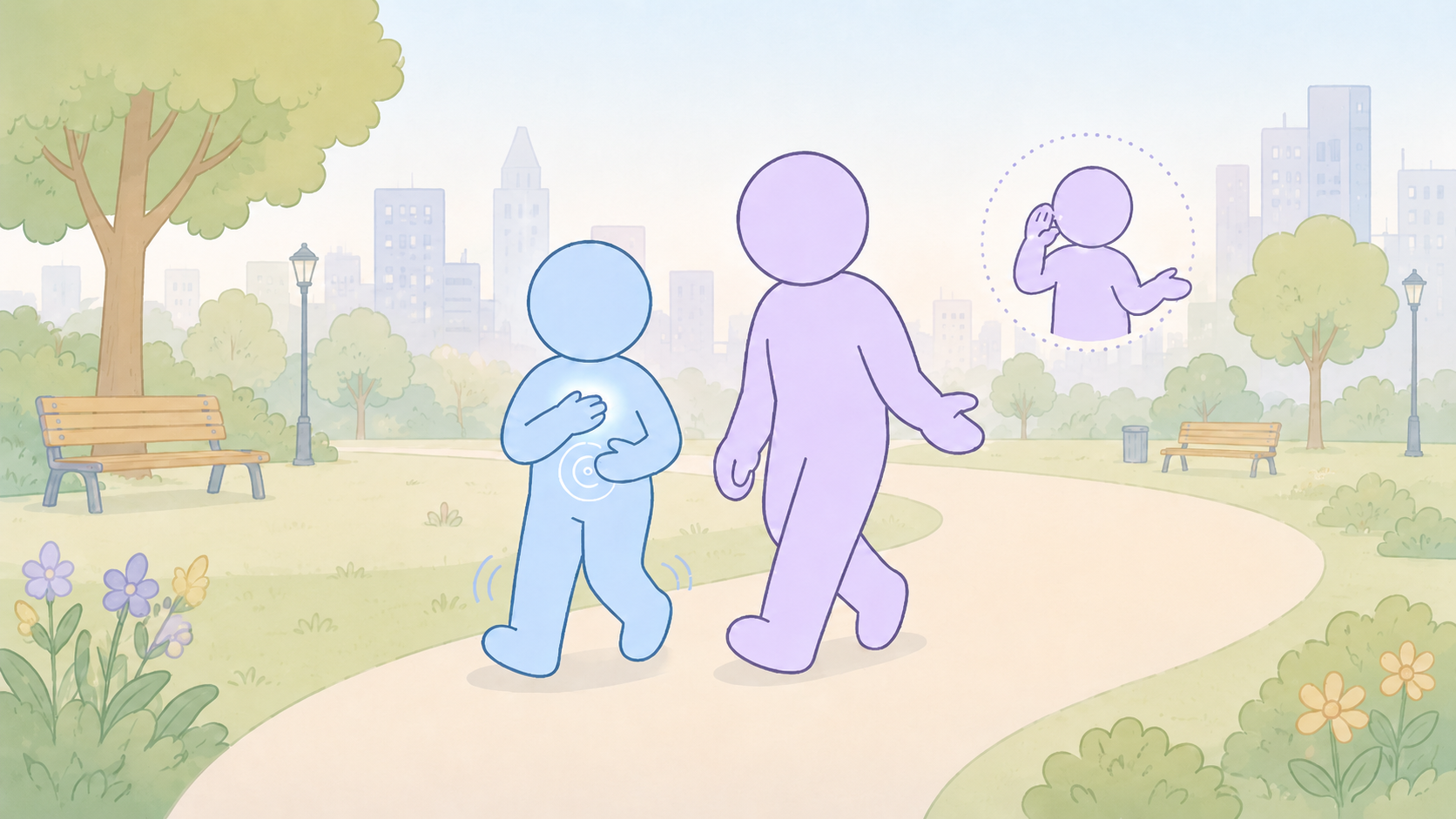
3. Walking and naming
Move together, and let body language come into the walk.
A walk around the block, around the yard, or even from one room to another can become a body-language practice. While walking, the adult names sensations out loud:
“My legs feel strong on this hill.” “The sun feels warm on my arms.” “My breath feels easier here.”
Movement makes sensations easier to notice. Walking side by side, rather than facing each other, lowers the social demand. The child doesn’t have to perform listening — they can absorb language in motion.
4. Shared vocabulary in real moments
When a child is having a body experience, name it gently without trying to fix it.
If a child is pacing, fidgeting, going quiet, or moving fast, the instinct is often to ask what is wrong or to redirect. A different option: name what the body might be telling us, without correcting it.
“Looks like your body might be moving fast right now.” “Your hands seem busy today.” “It sounds like the room might be loud.”
This is not interpretation. It is offering language. The child can take the word or leave it. Over time, sensation and word start to connect — which is the foundation for self-advocacy later on.
5. Rest without prescription
Build pauses into the day that are not earned and not labeled.
Calling something a “calm down break” makes rest a consequence. Calling it “quiet time” can make it feel like a demand to be quiet. A more useful version is something closer to a family pause — the adult lying down, the child invited to lie down too, no expectation either way.
The body learns that rest is available. It does not have to be earned by being upset first, or by performing exhaustion. For autistic kids who often run on borrowed regulation, having rest be ambient rather than prescribed changes what the body trusts.
How the Body Awareness series fits this work
The Shared Stories Studio Body Awareness series gives families shared narratives to support exactly the kind of language these practices build.
The stories are leveled across A, B, and C to meet learners at different stages of awareness and communication:
- Level A supports early sensory awareness — noticing body signals with a trusted adult
- Level B supports meaning-making — connecting sensations to patterns and experiences
- Level C supports reflection and self-advocacy — naming what the body needs and learning to ask for it
The practices above and the stories work together. The practices build the shared language. The stories give that language a place to live.
A different question
If you are with an autistic child this summer, it may be worth asking:
What signal might my child’s body be offering right now — and what would help them feel safe naming it?
The work of body awareness is not about identifying every sensation correctly. It is about building a relationship where the body is allowed to speak — and where someone is listening.
Explore the Body Awareness Series
The Shared Stories Studio Body Awareness series includes co-created, neurodiversity-affirming shared narratives designed to support body awareness, regulation, and shared understanding at home and at school.