
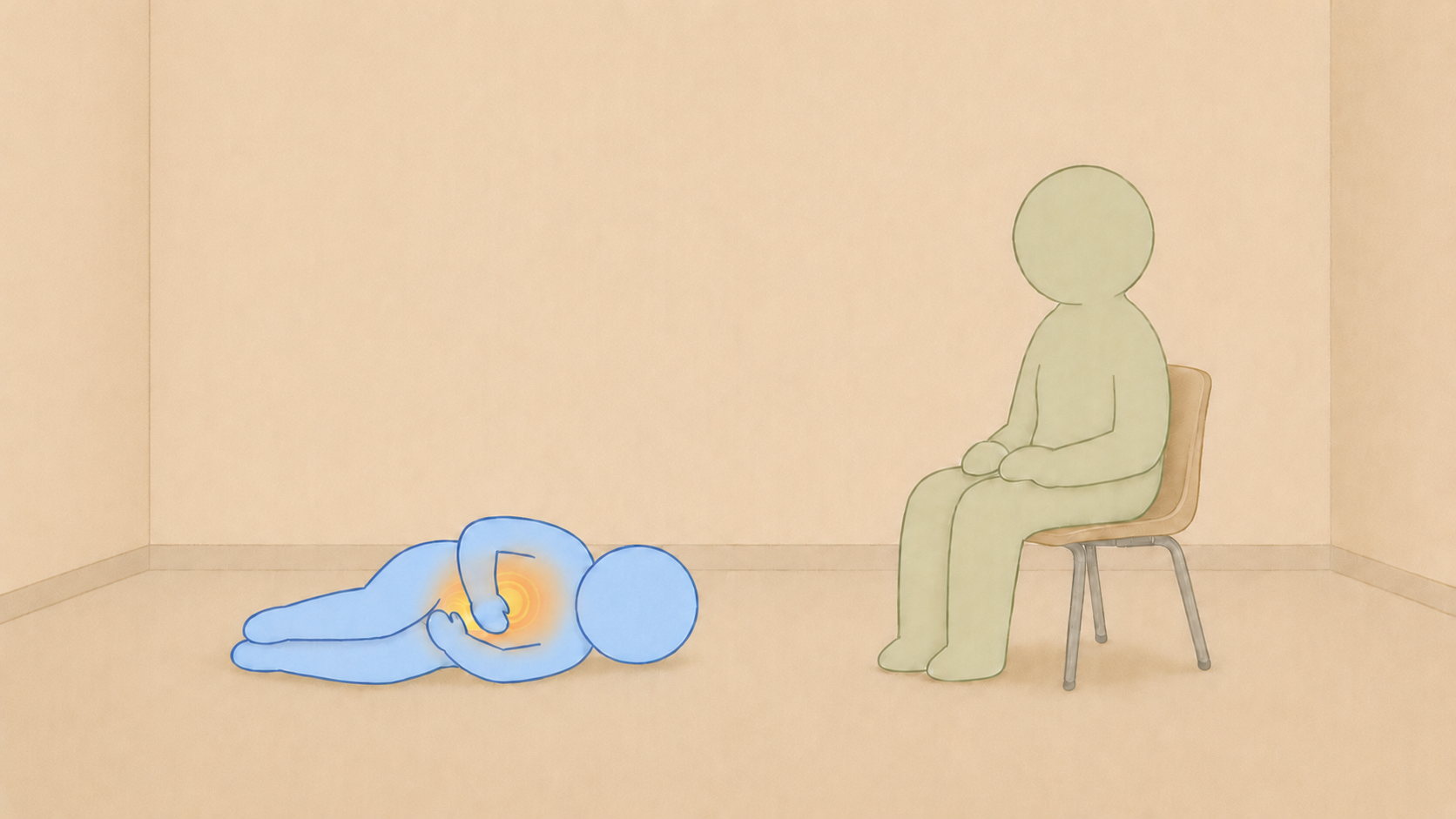
About twenty years ago, I worked as an autism consultant in a large school district. This was during the era of time-out rooms, before schools widely discussed the harms of isolation and well before sensory rooms became common.
A special education teacher brought a seven-year-old boy to the time-out room, and I met them there. She told me the problem. He was putting his hands in his pants, and it was disrupting the class.
He was already upset when they arrived. He became more upset.
The room was empty except for a chair.
I sat in the chair. He was on the floor.
I told him that other people did not like it when his hands were in his pants. I told him that when he was calm, and his hands had been out of his pants for five minutes, we could return to the classroom.
That is what I said. I want to be precise, because the temptation in telling something like this is to blur the details until the person telling it comes out looking better.
I sat in a chair in an empty room and informed a distressed seven-year-old that he could rejoin his class once his body had been acceptable for five consecutive minutes.
I was doing exactly what I had been trained to do.
What nobody asked
Every adult involved treated this as a social problem. The referral was about disruption. The intervention was about manners. My contribution was to add a timer.
Nobody asked what his body was doing.
A seven-year-old with his hands in his pants may be responding to something physical, sensory, or regulatory. He may need the bathroom and not recognize the signal in time. He may be constipated, which is common among autistic children and frequently undetected. He may have a urinary tract infection or be experiencing itching or pain that he cannot locate or name. He may be seeking pressure because that input helps organize his body when everything else has become too much.
Any one of those possibilities would make the behavior a form of information—not simply a social violation.
He was asked about none of them. He was asked to stop for five minutes.
I do not know what was happening for him. That is the part I have carried. I was in the room. I had the training. I had the title. And I walked out without the information because it never occurred to me to look for it.
The question was not on the table. Not for me, not for his teacher, not for anyone in that building.
The part I did suspect
There is one more possibility, and it is the one I have never been able to put down.
That boy spent his days in a school where children were told to have quiet hands. It was unremarkable at the time. It was written into behavior plans, printed on visual schedules, and repeated in the ordinary running commentary of every classroom.
Hands down. Hands still. Quiet hands.
A child who is told all day to stop moving his hands still has hands.
The need does not disappear because an adult has named it unacceptable. It may go somewhere less visible.
I suspected, even then, that what he was doing was anchoring—finding pressure and containment for hands that had been told, repeatedly and by everyone, that what they needed to do was not allowed.
I had the thought. I had nowhere to put it. Nothing in my training treated that kind of suspicion as information, so I set it down and ran the intervention I had been sent to run.
If that suspicion was right, the school helped produce the behavior. Then removed him from the classroom for it. Then sent for a consultant, who put a timer on it.
Over the next few days, I drew outlines of his hands on his desk so his teacher would have a quieter way to tell him where his hands belonged. I wrote him a descriptive social story about the situation.
Both addressed what his hands were doing.
Neither asked why.
The step underneath every strategy
Many schools have moved away from time-out rooms. “Quiet hands” has proved harder to dislodge.
And the assumption underneath both has not gone anywhere either: that the child already knows what is happening inside him.
Time-out assumed he knew and chose wrong. Many of the strategies that replaced it assume he knows and can tell us.
Consider what we hand to learners now:
- Take a break.
- Ask for help.
- Name your feeling.
- Go to the calm corner.
- Use your talker to tell me what you need.
Every one of those can be reasonable. Every one is an improvement on a room with two chairs in it.
And every one begins in the same place: a moment when the learner notices that something is happening inside them and registers it early enough to act on it.
Noticing is the prerequisite.
It appears on no strategy list I have ever been handed.
We never taught the first step.
The first step has a name
Interoception is the sense that carries information from inside the body—hunger, thirst, temperature, needing the bathroom, muscle tension, heart rate, breath, pain, and the physical shifts that may accompany strong emotion. Understanding the connection between interoception and meltdowns helps explain why escalation can appear to happen without warning.
It is how a person knows they are getting hungry before they are starving. It is how they notice that their shoulders have crept up toward their ears. It is how something registers as beginning to feel wrong before it becomes unbearable.
For many adults, this runs quietly in the background and has done so for so long that it has become invisible. We do not experience it as a skill. We experience it as simply knowing.
Which is precisely why it may not occur to us to support it. We do not support what we assume everyone already knows.
Four ways body signals may be experienced
For many autistic and neurodivergent people, internal information may not reach conscious awareness in the form—or on the timeline—our strategies assume.
Signals may arrive faintly—present, but too quiet to notice or identify.
Signals may arrive late—after the body has already reached its peak, when there is no longer any margin in which a break or a sentence would help.
Signals may arrive loudly—with no noticeable smaller version first. Not a rising volume, but silence and then an alarm.
Signals may arrive unclearly—so that hunger, anxiety, anger, pain, and needing the bathroom all produce similar sensations, and telling them apart requires discrimination nobody has ever supported.
Now set any one of those next to “use your words.”
A learner whose signals arrive faintly is being asked to describe information that may be too quiet to detect.
A learner whose signals arrive late is being asked to report on information they cannot access yet.
A learner whose signals arrive loudly may have no early version to describe.
A learner whose signals arrive unclearly is being asked to name one feeling when several different experiences register in much the same way.
The gap is not refusal.
The learner may be receiving a question their body has not answered yet.
This is one reason a meltdown can seem to come out of nowhere. It may have begun inside a body whose early information never reached conscious awareness in time.
What this would cost you
This is where a teacher may reasonably think: I do not have time for this. I have twenty-six children, a math block, an IEP meeting at lunch, and a fire drill at ten. You are describing a curriculum I have no room for.
That is fair.
I am not describing a curriculum.
What I am describing costs almost nothing in time because it happens inside moments that are already happening. It is a change in what gets said, not necessarily an addition to what gets done.
The hard conversation after a hard morning is going to take place either way. The question is whether it goes looking for information or goes looking for compliance.
The difference, in practice
“Your movements got bigger just now. I wonder what it felt like right before.”
Not: “You need to use your words.”
“Something in you knew before I did.”
Not: “Why didn’t you tell me?”
“I’m going to sit right here. You don’t have to talk.”
Not: “Take a deep breath.”
“Does anything hurt? Does anything feel strange?”
Not: “We don’t do that here.”
The first line in each pair looks for information. The second assumes the learner already understood what was happening and could have acted differently.
None of these lines is limited to school. They work at a kitchen table at six o’clock, on a day that has already gone badly, when there is no program left in anyone.
That is the entire shift.
Not a program. A different starting assumption about what a body is doing when it does something inconvenient.
The part that stays hard
I want to be careful not to make this sound like a solution.
It is not one.
A learner who understands more about what their body does will still have days when noticing arrives too late to be useful. An adult who does all of this well will still sit through moments that go badly and will still leave some of them without ever knowing what happened.
Understanding does not reduce how often hard moments occur.
It changes what the learner is left holding afterward.
What they carry out of the room might be something happened in my body, and someone helped me understand it.
Or it might be I did something wrong again.
That is not a small difference.
It is also not the same as stopping the behavior.
Where to start
The question I was asked in that district, over and over, was:
What do I do when the behavior escalates?
It is the wrong starting question, and it took me a long time to hear why. It begins after the part that matters, and it asks about my response rather than the learner’s experience.
A better question is:
What might this body have been reporting that nobody helped the learner notice?
Start there.
Before the strategy, before the plan, before the timer—look for what the body may have been reporting, and begin from the assumption that the behavior contains information.
That question is what the free guide is built around. It explores what escalation can look like from the inside—why the early signal may not arrive in time, what a body may be reporting during the buildup and at the peak, and what an adult can say once a difficult moment is already underway.
The paired lines above are included as a print-and-keep card.
It costs nothing.
I never learned why that boy put his hands in his pants.
Someone else’s child still has time.