
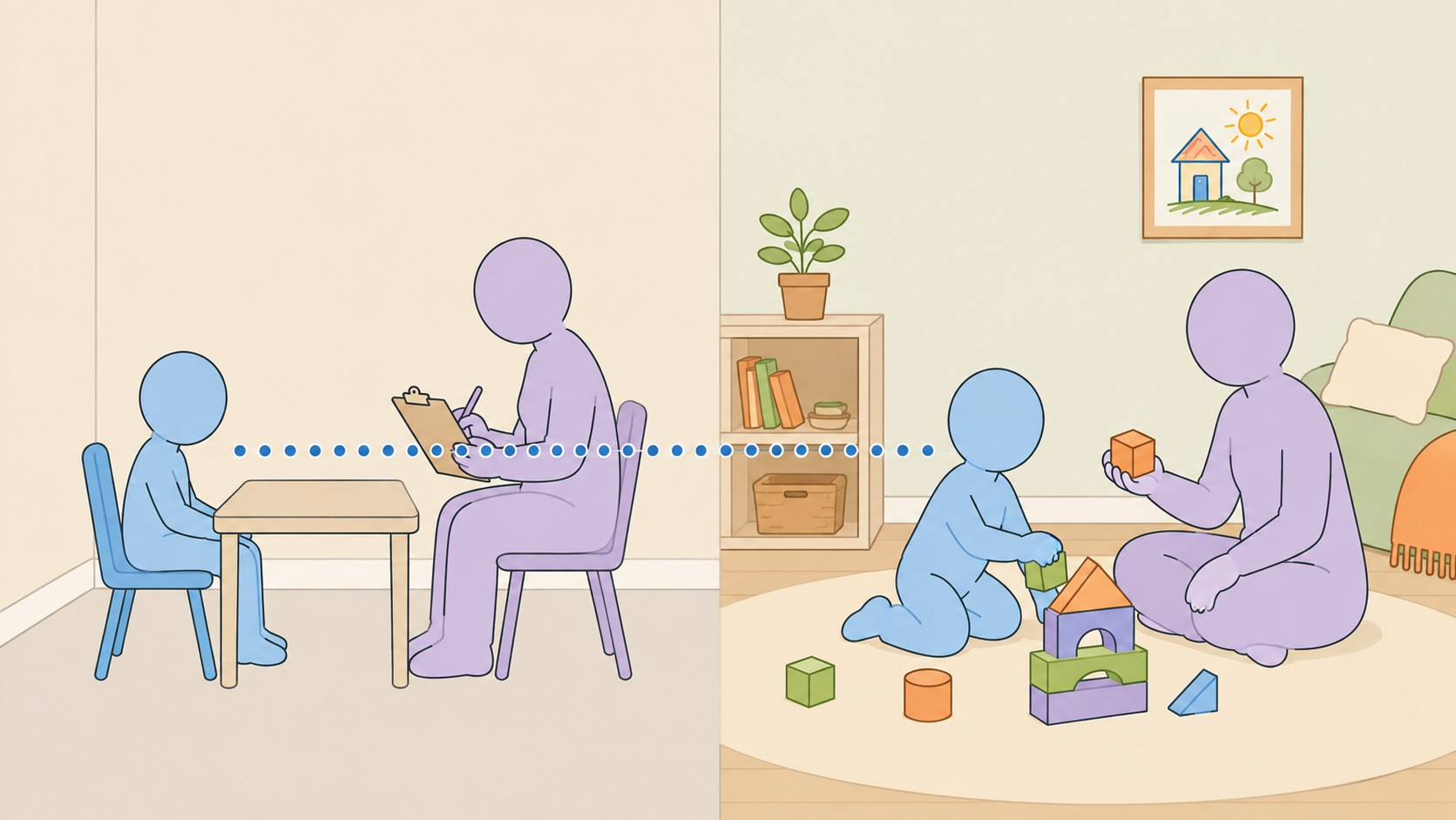
“He Does That All the Time at Home”
What I Heard for Forty Years and Did Not Challenge
It comes early in the meeting, usually while the present levels are being reviewed and someone is reading aloud a list of what the child does not yet do.
A parent says it. Sometimes it is a mother. Sometimes a father, grandmother, or aunt who took the morning off work to be there.
The wording varies a little. The sentence almost never does.
The tone varies more, and it is rarely neutral. There is usually a small edge of frustration or confusion—the sound of someone listening to a description of a child that does not match the child they know.
“He does that all the time at home.”
And someone at the table—the SLP, the OT, the teacher—answers:
“Well, he doesn’t do it here. So that’s what we need to work on.”
The meeting moves on. Someone reads the next section of the report.
I have been at that table more times than I can count: in district conference rooms, school libraries, and once at a cafeteria table pushed against a wall.
I have heard that exchange for forty years.
For most of those years, I did not challenge it.
What just happened?
The parent brought data.
They brought information about what their child does at home, with familiar people, during the routines that make up their actual life. No clinician in the room had access to all of that. The parent did.
And the information was quietly set aside.
Usually, no one was trying to be dismissive. The response might even have sounded warm and reassuring.
But underneath it was an assumption:
What happens in this room counts as evidence. What happens at home is anecdotal.
The room became the official version of the child.
Home became something the parent claimed.
The niggle
I have written before about the niggle—that persistent sense that something is wrong before I have the language to explain why.
This exchange triggered it every time.
I knew that a child doing something spontaneously at home, in the middle of ordinary life, was stronger evidence of a usable skill than producing it on request in a therapy room.
At home, no one had arranged the materials, given the prompt, waited five seconds, or repeated the direction.
The child simply used the skill because there was a real reason to use it.
I knew that mattered.
And I stayed quiet.
I told myself it was not my meeting. The goal was already written. The team had already agreed. I did not yet have the words for my objection.
That last part was true.
It was also a very convenient reason not to make the meeting longer.
The girl who needed glasses
Years ago, I worked with a little girl who had been diagnosed with autism during a hospital evaluation.
I saw her at preschool. She was withdrawn and flat. She did not look toward faces. She rarely engaged with the materials or the other children.
Everything in the preschool room seemed to confirm what was written in her file.
Then I saw her at home.
She was playful. She sought people out. She was funny.
The difference was not subtle.
I could not make the two presentations fit together, so I stopped trying to decide which one was the “real” child. I started paying attention to what was different between the settings.
Eventually, I noticed that she held everything very close to her eyes.
She saw an eye doctor. She got glasses.
After that, much more of the child her mother had been describing—the playful child who sought people out—began showing up at preschool.
She had been assessed in an unfamiliar place by unfamiliar adults while trying to function without clear vision. Adults were interpreting her behavior without understanding her access to the environment, and what she did under those conditions became part of her permanent record.
Her mother had been telling us all along that she was different at home.
That difference was not an inconvenience to the assessment.
It was information.
What I once believed about carryover
I was not quiet only because I was being polite.
Some part of me agreed with the way the system worked.
I had been trained to believe that a skill was first established in a controlled setting and then carried outward.
First acquisition. Then practice. Then generalization.
The service-delivery model made that belief easy to maintain: thirty minutes, once a week, in a room down the hall, with an adult who appeared nowhere else in the child’s life, using materials that appeared nowhere else either.
What is an arrangement like that designed to produce?
Performance in that room, with that adult, using those materials.
And that is often what it produced.
Then we sat in meetings and treated the absence of that performance everywhere else as the child’s failure to generalize.
We rarely asked whether the intervention had generalized.
If a skill appears only in the place where it was taught, we have not yet created a functional skill.
We have created a therapy-room performance.
I was working in both rooms
I spent twelve years working in schools, and during that time I also had a private practice.
That meant I was the same clinician, with the same training, seeing children in very different environments—and sometimes seeing the same child in both.
Same child. Same clinician. Different room.
The differences were not subtle.
Children communicated differently. Moved differently. Played differently. Tolerated different amounts of language. Needed different kinds of support.
Had I seen only one setting, I would have written a different description of the child.
What the natural environment changes
Three things stand out to me now.
Regulation is more available
A nervous system in a familiar place, with familiar people and familiar routines, may have more capacity available for communication and learning.
A nervous system in an unfamiliar room, with an unfamiliar adult, under observation, may be using much of that capacity simply to stay organized.
We have often measured children when they were least regulated and called the result their baseline.
The reason is real
Much of the communication we create in therapy is manufactured.
We hold the preferred object. We create a reason to request. We ask a question when we already know the answer. Then we reinforce the response we arranged.
In ordinary life, a child communicates because something is actually happening.
They want food because they are hungry.
They protest because something is uncomfortable.
They ask where someone went because they noticed the person was missing.
The reason belongs to the child. So does the communication.
The cues are real
In a therapy room, I supply the cues. That means I quietly become part of the skill.
The actual environment contains different information.
A real fire alarm is loud in a way a picture of one cannot capture.
A substitute teacher is genuinely unfamiliar.
A crowded lunchroom places different demands on a child than a quiet speech room.
The environment is not background.
It is part of the task.
What I am not saying
I can hear the objection because I have heard it from clinicians I respect:
“I have sixty-two children on my caseload. I get twenty-five minutes with each one. There is no mechanism for home visits, no coverage for me to leave the room, and a schedule created by someone who has never met these children. What exactly am I supposed to do?”
That objection is valid.
I am not suggesting that school-based clinicians leave the schools. They reach children who may not receive support anywhere else.
I am also not suggesting that home-based private practice is automatically better. Every setting has its blind spots.
The problem is not that clinicians do not care.
The problem is a service model that separates learning from living and then measures children on the gap it created.
We cannot remove every constraint.
But we can stop pretending the therapy room is neutral.
What we can bring in
Treat the parent’s report as data
When someone says, “He does that all the time at home,” the most useful response is not a correction.
It is:
“Tell me more.”
“What was happening?”
“Who was there?”
“Did someone ask him to do it, or did he initiate it?”
Those questions are not polite conversation before returning to the real data.
They help us identify the conditions under which the skill is accessible.
Observe the real setting when possible
This does not have to mean a home visit.
Most SLPs, OTs, and special educators are already doing versions of this during the school day.
Go to the hallway during a transition.
Watch arrival.
Join the lunch line.
Observe the learner using AAC during a classroom activity rather than only during speech.
See what happens during recess, dismissal, a fire drill, or a schedule change.
One observation in the real setting may explain something that twelve sessions in the therapy room did not.
Bring the real situation into the work
When direct observation is not possible, we can still stop teaching decontextualized skills.
We can work through situations learners actually encounter: a fire drill, a substitute teacher, an appointment, a schedule change, a body signal that is hard to interpret, or an AAC device that has begun to feel like a demand.
This is much of why I build what I build now.
I want the learner to explore their own experience, not study an abstraction created by an adult.
Support understanding in the
situations that actually happen.
I created Shared Stories Studio to offer leveled, regulation-first resources for autistic and neurodivergent learners—built around real experiences such as fire drills, school changes, substitute teachers, body signals, anxiety, and more.
Write goals that include the conditions
A goal should tell us more than what the child will do.
Where will the skill be used?
With whom?
For what reason?
With what support?
A child may communicate differently with a parent than with a teacher. They may answer direct questions in therapy but communicate spontaneously during play. They may use AAC when no one is watching and push it away when an adult says, “Use your device.”
Those differences are not noise around the skill.
They are part of the skill.
When a goal does not name the setting, the people, and the conditions, the therapy room fills in the blanks.
It always does.
Where this lands
I still sit at those tables, usually accompanying the family.
I am there differently now.
When a parent says, “He does that all the time at home,” I no longer wait to see whether someone else will respond.
I say:
“Tell me more about that. What is different at home?”
Once, I thought the room was where we discovered what a child could do.
Now I think the room mostly tells us what a child can do in that room.
That is one reason I create Shared Stories Studio resources around situations learners actually encounter. They begin with regulation, use first-person language, and leave room for learners and the people who know them to bring in what is already true.